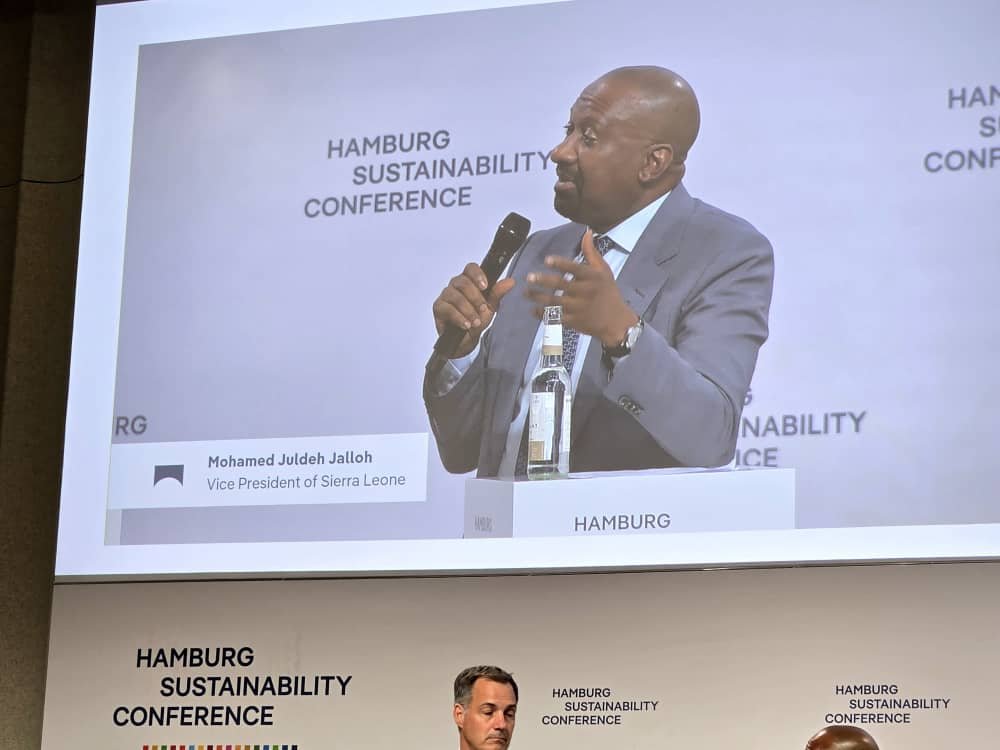
Sierra Leone's Vice President, Dr. Mohamed Juldeh Jalloh, emerged as one of the leading voices for developing nations at the Hamburg Sustainability Conference (HSC) 2026, where he joined heads of state, senior government officials, multilateral development bank presidents and United Nations leaders in discussions on strengthening global resilience and sustainable development.
Held on Monday, 29 June 2026 in Hamburg, Germany, the conference brought together some of the world's most influential policymakers and financial leaders to address pressing global challenges, including geopolitical tensions, economic instability, climate resilience and sustainable development financing.
Vice President Juldeh Jalloh participated alongside distinguished global figures, including German President Frank-Walter Steinmeier, World Trade Organization Director-General Dr. Ngozi Okonjo-Iweala, Asian Development Bank President Masato Kanda, United Nations Deputy Secretary-General Amina J. Mohammed, Germany's Federal Minister for Economic Cooperation and Development Reem Alabali-Radovan, United Kingdom Minister of State for International Development and Africa Baroness Jennifer Chapman, United Nations Development Programme (UNDP) Administrator Alexander De Croo, and President of the African Development Bank Group Dr. Sidi Ould Tah.
From the official leaders' gathering at Hamburg's historic City Hall to the conference's high-level policy sessions, the Vice President actively engaged fellow world leaders and development partners, reinforcing Sierra Leone's growing influence in international discussions on sustainable development, economic resilience and global cooperation.
A defining moment of his participation came during the high-level panel discussion titled "Navigating the Hormuz Crisis: Forging a Collective Response," which followed a keynote address by United Nations Deputy Secretary-General Amina J. Mohammed.
Speaking from the perspective of both a former United Nations governance and security expert for West Africa and the Sahel and the leader of an import-dependent African economy, Dr. Juldeh Jalloh highlighted the severe consequences that geopolitical conflicts have on developing nations.
He observed that disruptions to strategic shipping routes, particularly the Strait of Hormuz, extend far beyond fuel markets and create widespread economic hardship for vulnerable countries.
"For the Global South, an oil shock is never just an oil shock. It becomes a food shock, a fiscal shock, and ultimately a human development shock," the Vice President stated.
He explained that increases in global oil prices rapidly translate into higher costs for fuel, food, fertiliser, electricity and transportation, placing enormous strain on national budgets and slowing economic growth in low-income countries.
The Vice President urged the international community to recognize food and energy security as essential pillars of global stability rather than domestic policy concerns, stressing that geopolitical crises in one region often have devastating consequences for millions of people living thousands of miles away.
Beyond outlining the challenges facing developing economies, Dr. Juldeh Jalloh presented practical proposals aimed at strengthening the international financial system and improving global resilience.
He called on multilateral development banks, including the African Development Bank and the World Bank, to establish a Global South Shock Absorption Facility that would provide rapid, flexible financing to countries affected by geopolitical instability and supply chain disruptions before such crises escalate into humanitarian emergencies.
Drawing parallels with international climate financing mechanisms, the Vice President argued that global financial institutions should move beyond financing recovery after disasters and instead invest in preventive resilience that enables vulnerable economies to withstand external shocks.
"We must shift from financing recovery after crises to financing resilience before they occur," he emphasized.
He noted that countries like Sierra Leone require responsive financial instruments capable of cushioning economies against sudden external shocks while protecting critical investments in health, education, agriculture and infrastructure.
His intervention received considerable attention during the conference and reinforced growing calls for reforms that make the international financial architecture more responsive to the realities confronting developing countries.
Observers noted that Sierra Leone's contribution elevated the country's profile from being a participant in global discussions to becoming an active contributor of policy solutions aimed at strengthening economic resilience across the Global South.
Throughout the conference, Vice President Juldeh Jalloh also held engagements with international leaders, development partners and representatives of multilateral institutions, further strengthening Sierra Leone's diplomatic presence on the global stage.
His participation underscored the country's commitment to constructive international engagement and demonstrated Sierra Leone's determination to contribute meaningfully to shaping policies that promote equitable growth, sustainable development and inclusive global prosperity.
As the Hamburg Sustainability Conference concluded its deliberations, Sierra Leone's Vice President left a strong impression as a persuasive advocate for developing nations, calling for greater international solidarity, stronger multilateral cooperation and financial reforms capable of protecting vulnerable economies from increasingly complex global challenges.
His message resonated clearly throughout the conference: sustainable development cannot be achieved without ensuring that developing countries have the financial resilience and international support needed to withstand the economic consequences of geopolitical crises beyond their control. https://thecalabashnewspaper.com/vice-president-dr-mohamed-juldeh-jalloh-emerges-as-a-strong-voice-for-the-global-south-at-hamburg-sustainability-conference/

No comments:
Post a Comment