By Amin Kef (Ranger)
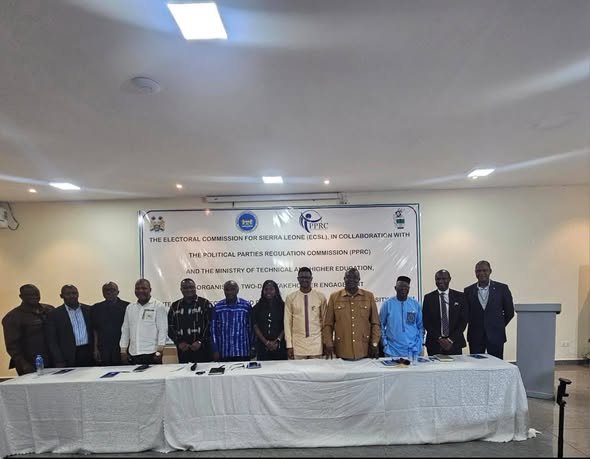
The Electoral Commission for Sierra Leone (ECSL) has concluded a two-day stakeholders' engagement aimed at integrating Electoral Administration and Political Education into the country's university system, marking what officials described as a significant step towards strengthening democratic governance.
The forum, held in Freetown from 11 to 12 June 2026, was organised in collaboration with the Political Parties Regulation Commission (PPRC) and the Ministry of Technical and Higher Education. The initiative is anchored in Recommendation 13 of the Cross-Party Committee Report on Electoral Systems and Management Bodies' Review, which advocates the inclusion of governance and electoral studies in school and university curricula.
Addressing university vice chancellors, principals, curriculum development experts, media representatives, and other stakeholders, the Chief Electoral Commissioner and Chairman of ECSL, Edmond Sylvester Alpha, described the engagement as a "deliberate and historic step" towards reshaping Sierra Leone's electoral culture.
He noted that the gathering represented a direct response to the Cross-Party Committee's recommendation that the Electoral Commission work with educational authorities to incorporate governance and electoral topics into the nation's educational system while strengthening civic and voter education initiatives.
According to Alpha, the report emerged from an inclusive national dialogue and called for the development of academic programmes on electoral administration and governance in collaboration with universities and other tertiary institutions.
"We are moving from recommendation to action," he said, adding that the initiative seeks to build a generation of Sierra Leoneans who understand democracy, elections, and civic responsibility.
The ECSL Chairman stressed that elections should not be viewed as isolated events that occur every five years but as a permanent pillar of democracy sustained by informed citizens, professional administrators, and a political culture rooted in integrity.
He observed that knowledge of election management, legal frameworks, logistical systems, and ethical standards has largely remained within a small group of practitioners and said the proposed curriculum would broaden access to that expertise.
Alpha identified three major benefits expected from the institutionalisation of electoral education.
Firstly, he said it would create a professional pipeline by nurturing future electoral administrators, researchers, political and civic educators with both academic and practical knowledge of democratic processes.
Secondly, he explained that integrating political education into university programmes would help foster a culture of electoral integrity by promoting tolerance, non-violence, and respect for the rule of law among future leaders in politics, civil society, the media, and public institutions.
Thirdly, he maintained that an educated electorate remains the strongest defence against misinformation, electoral manipulation, and political apathy.
The ECSL Chairman emphasised that the two-day engagement was not merely about introducing another academic subject but about developing a comprehensive and non-partisan curriculum through collaboration.
Participants were invited to deliberate on the content of an electoral studies programme, ways of balancing theory with the practical realities of Sierra Leone's electoral system, and strategies for tailoring courses to undergraduate, postgraduate, and professional certification levels.
He also highlighted the need for teaching approaches that would not only educate students about elections but also cultivate civic values capable of shaping responsible public conduct.
Alpha praised the expertise of university leaders and curriculum specialists, describing them as the driving force behind the initiative.
"The Electoral Commission brings technical knowledge of election management, while the academic community provides the rigour and institutional authority required to teach and certify these programmes," he said.
Reaffirming the Commission's commitment, Alpha disclosed that ECSL would provide institutional knowledge, resource materials, and technical personnel to support the implementation process.
He also announced plans to facilitate internships, election observerships, and joint research programmes for students.
The ECSL Chairman expressed the hope that, in the near future, graduates from Sierra Leonean universities would complete courses in electoral democracy that equip them to contribute meaningfully to credible elections.
He further called on the academic community to take ownership of the initiative, stressing that its long-term success would depend on the commitment of universities.
In a separate address during the workshop, Alpha underscored the importance of developing a curriculum in Electoral Governance for higher education institutions.
He noted that the quality of democratic institutions depends largely on the quality of citizens, leaders, and electoral practitioners produced through education.
According to him, credible elections require strong institutions, sound legal frameworks, ethical leadership, informed citizens, and competent electoral administrators.
He observed that modern electoral processes have become increasingly complex, involving issues such as voter education, electoral technology, election security, campaign financing, dispute resolution, misinformation, gender inclusion, youth participation, and electoral integrity.
Alpha therefore argued that higher education institutions should offer structured programmes capable of preparing a new generation of professionals to effectively manage and support democratic processes.
He also stressed the importance of collaboration among electoral bodies, ministries, universities, civil society organisations, development partners, political parties, and the media to ensure that the curriculum reflects both international best practices and Sierra Leone's national realities.
Concluding the engagement, the ECSL Chairman described democracy as a learned behaviour sustained by knowledge, values, and habits passed from one generation to another.
He said embedding electoral administration and political education in the university system would help professionalise democracy, strengthen electoral integrity, enhance citizen participation, and contribute to peaceful and credible elections for generations to come. https://thecalabashnewspaper.com/ecsl-chairman-urges-universities-to-drive-democratic-governance-education/

No comments:
Post a Comment