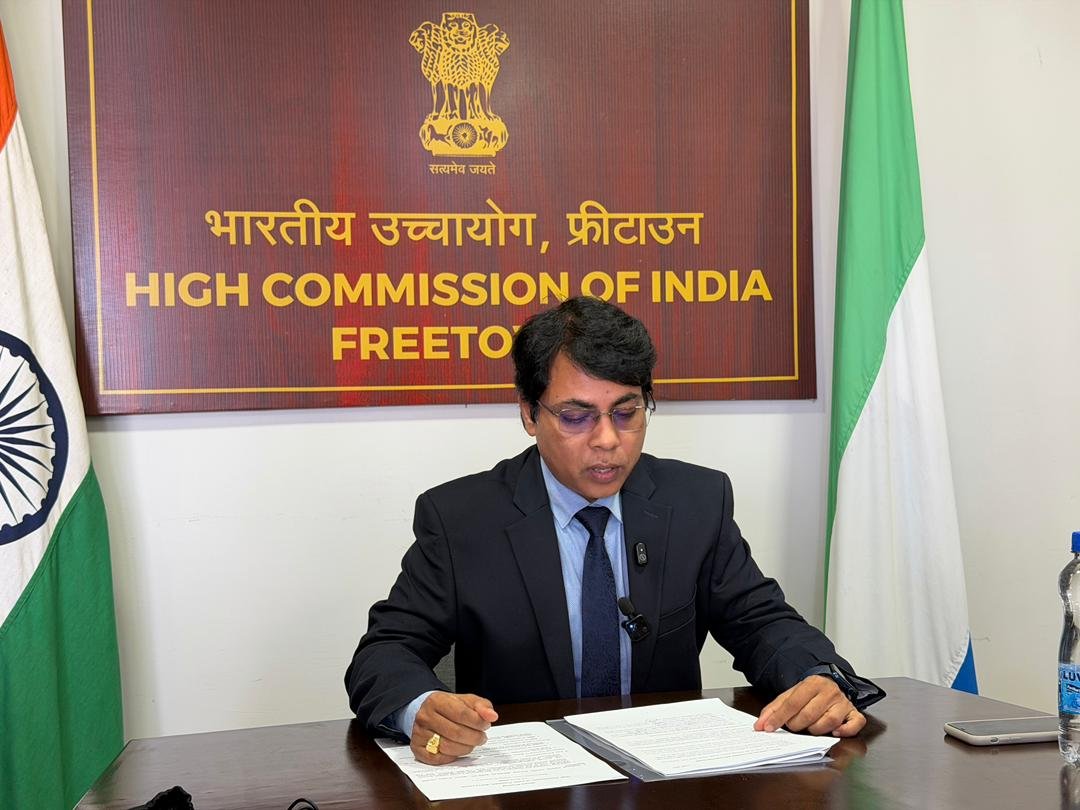
India has recorded remarkable progress in healthcare, women's empowerment, digital inclusion, financial protection, and social development, according to findings from the Sixth National Family Health Survey (NFHS-6), which were presented during a media briefing hosted by the High Commission of India in Freetown on Wednesday, 17 June 2026.
Addressing journalists, Mr. Neeraj Kumar Saini, Chargé d’Affaires a.i. of the High Commission of India in Sierra Leone, described the survey as a major milestone in the country's public health journey and a testament to the effectiveness of sustained government investments in healthcare, nutrition, sanitation, women's empowerment, and digital transformation.
The NFHS-6 survey, conducted during 2023–2024 by the International Institute for Population Sciences (IIPS), Mumbai, covered nearly 679,000 households, more than 700,000 women, and 715 districts across India. It is regarded as one of the world's largest health and demographic surveys, providing comprehensive data on maternal and child health, nutrition, fertility, family planning, immunization, non-communicable diseases, and social welfare indicators.
Mr. Saini disclosed that India has achieved near-universal access to essential services, with electricity coverage reaching 98.3 percent nationwide and 97.8 percent in rural communities. Access to improved drinking water has risen to 96.5 percent, while health insurance coverage has expanded significantly to 60.2 percent, reflecting growing financial protection for millions of households.
The survey also highlighted substantial gains in women's empowerment. According to the findings, 89 percent of women now participate in household decision-making and an equal percentage own and operate bank accounts. Mobile phone ownership among women has increased considerably, while internet usage among women has surged to 64.3 percent, almost doubling from previous survey levels. These developments, Mr. Saini noted, demonstrate the success of India's efforts to bridge gender and digital divides.
On demographic trends, the survey revealed that child marriage has declined sharply over the past two decades. The proportion of women aged 20 to 24 who were married before the age of 18 dropped from 47.4 percent in 2005–2006 to 20.1 percent in 2023–2024. India's Total Fertility Rate has also stabilized at 2.0, indicating replacement-level fertility and a consolidated demographic transition.
Significant progress was equally recorded in maternal and child healthcare. Institutional deliveries have risen to 90.6 percent, while 91.3 percent of births are now attended by skilled health personnel. Nearly 96 percent of pregnant women received antenatal care, and full immunization coverage among children increased to 87.1 percent.
Mr. Saini emphasized that these achievements are supported by India's extensive public health infrastructure, including more than 187,000 operational Ayushman Aarogya Mandirs and Health and Wellness Centres across the country. These facilities have brought essential healthcare services closer to communities, particularly in rural and underserved areas.
He further noted that India's telemedicine programme, eSanjeevani, has delivered more than 467 million consultations, significantly improving access to healthcare services through digital platforms. The country has also strengthened disease prevention and screening programmes, with hundreds of millions of citizens screened for hypertension, diabetes, and various forms of cancer.
The survey recorded encouraging improvements in child nutrition. Stunting among children declined from 38.4 percent to 29.3 percent over the last decade, while severe wasting reduced from 7.4 percent to 5.2 percent. Early breastfeeding practices have also improved considerably, contributing to better child health outcomes.
While celebrating these achievements, Mr. Saini acknowledged emerging public health challenges, particularly the growing burden of obesity, diabetes, hypertension, and other non-communicable diseases. He noted that the Government of India continues to invest heavily in preventive healthcare, health promotion campaigns, and large-scale screening programmes to address these concerns.
The survey also highlighted progress in reducing gender-based violence, increasing financial inclusion, and expanding access to education and digital services. Nearly 98.2 percent of households now have access to bank or post office accounts, driven largely by India's Jan Dhan-Aadhaar-Mobile (JAM) ecosystem and direct benefit transfer programmes.
According to Mr. Saini, the NFHS-6 findings demonstrate the transformative impact of evidence-based policymaking and sustained investment in human development.
"The findings of NFHS-6 underscore India's remarkable progress in improving health outcomes, empowering women, expanding digital and financial inclusion, and strengthening public health systems. These achievements reflect the Government of India's commitment to inclusive development and the well-being of over 1.4 billion people," he stated.
The High Commission of India also emphasized that India's experiences in strengthening primary healthcare, expanding immunization coverage, promoting women's empowerment, and leveraging digital public infrastructure offer valuable lessons for developing countries, including Sierra Leone.
The briefing concluded with a reaffirmation of India's commitment to advancing Universal Health Coverage and achieving the Sustainable Development Goals through inclusive development, stronger public institutions, and continued investments in the health and well-being of its citizens. https://thecalabashnewspaper.com/india-high-commission-highlights-major-public-health-progress-through-nfhs-6-survey-findings/

No comments:
Post a Comment