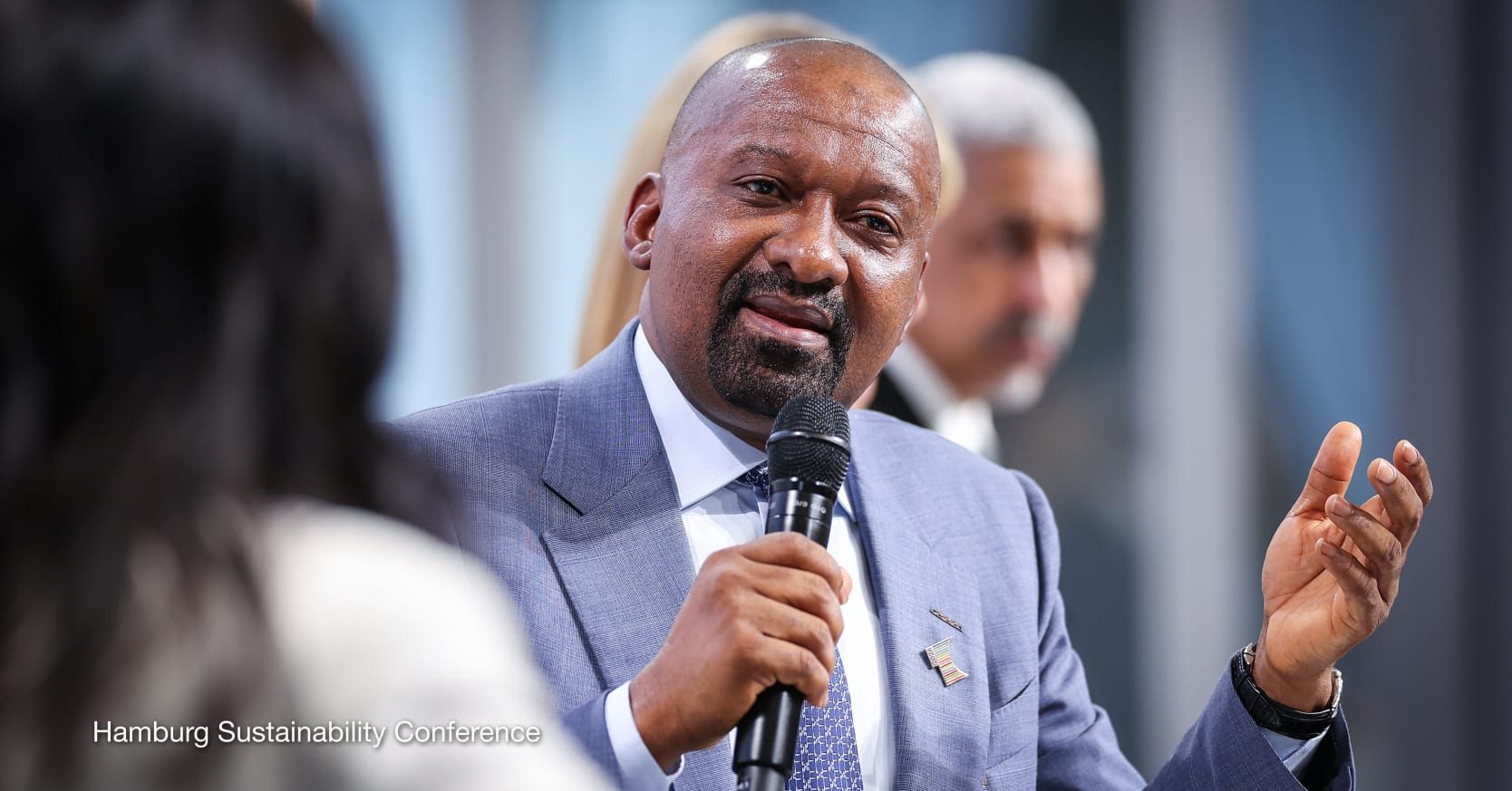
Sierra Leone’s Vice President, Dr. Mohamed Juldeh Jalloh, has called for urgent reforms to the international development financing system, warning that rising debt obligations, declining development assistance and recurring global economic shocks are forcing African Governments to make difficult decisions that undermine long-term investments in education, healthcare, infrastructure and economic growth.
Speaking during an interview with international development news platform Devex at the Hamburg Sustainability Conference in Germany, Vice President Dr. Mohamed Juldeh Jalloh highlighted the growing financial pressures facing developing countries, particularly Sierra Leone, where successive global crises have significantly reduced the Government’s capacity to finance essential development programmes.
He cited the COVID-19 pandemic, Russia’s invasion of Ukraine and more recent geopolitical tensions in the Middle East as examples of external developments that have disrupted national budgets, increased food and energy costs and weakened economic stability.
According to the Vice President, Sierra Leone spends approximately 42 percent of its domestic revenue on debt servicing, leaving limited resources to address unexpected economic pressures while maintaining essential public services.
“You are left as a Government to trade off what are priorities that we can do now and what we can delay,” he explained, describing the situation as the “politics of painful choices.”
Illustrating the country's growing development needs, Vice President Dr. Mohamed Juldeh Jalloh disclosed that approximately 720 children are born in Sierra Leone daily, creating demand equivalent to 14 additional classrooms every day.
He questioned how Governments could postpone the construction of schools and hospitals when demand for those facilities continues to increase, stressing that limited financial resources often force policymakers to choose between competing national priorities.
Despite those challenges, the Vice President highlighted progress achieved since President Dr. Julius Maada Bio assumed office in 2018, including an increase in healthcare budgetary allocations from six to eleven percent, improvements in maternal healthcare, increased girls’ enrolment in secondary schools and universities, and a reduction in inflation from nearly 48 percent to single digits.
However, he cautioned that such achievements remain vulnerable to recurring international economic disruptions, arguing that fragility should no longer be associated exclusively with political instability, conflict or weak institutions.
“Unpredictability itself is a vehicle of fragility,” Vice President Dr. Mohamed Juldeh Jalloh stated, explaining that repeated external shocks can undermine development progress even in countries pursuing responsible economic policies.
Addressing the debt burden confronting developing economies, the Vice President acknowledged that debt restructuring, debt swaps and debt buybacks could provide temporary relief but maintained that they do not offer sustainable solutions to long-term financial challenges.
He therefore proposed the establishment of an international shock absorption facility that would provide vulnerable countries with access to flexible, prearranged financing during sudden increases in commodity prices, geopolitical conflicts and other external economic disruptions.
Vice President Dr. Mohamed Juldeh Jalloh also urged the international community to invest in what he described as “resilience infrastructure,” particularly in agriculture and energy, to reduce African countries’ dependence on imported commodities and strengthen their ability to withstand future crises.
“The objective is to grow the economy,” he emphasized. “When we grow the economy, then we are not obliged to be taking debts.”
Meanwhile, prominent British-Sudanese businessman and philanthropist, Mo Ibrahim, speaking at the opening of the Hamburg Sustainability Conference, criticised international credit rating agencies for what he described as excessive assessments of investment risks across Africa.
Mo Ibrahim argued that the classification of nearly all African economies below investment grade has increased borrowing costs and discouraged major international investors, including pension funds, from financing development projects on the continent.
“Nobody invests in you. Or they ask for a huge premium,” he stated, highlighting the difficulties African countries face in accessing affordable international capital.
However, Mo Ibrahim also challenged African Governments to address internal obstacles to investment, particularly political instability, armed conflict, corruption and unconstitutional changes of Government.
He maintained that peace, good governance and accountable leadership remain essential conditions for attracting sustainable investment, questioning whether military coups have delivered meaningful prosperity to African populations.
Mo Ibrahim further expressed concern over illicit financial flows, claiming that Africa loses approximately US$90 billion annually through practices including corporate profit shifting and tax avoidance.
He called on multinational companies and Western financial institutions to support greater transparency and ensure that African countries receive their rightful share of tax revenues.
The contributions of Vice President Dr. Mohamed Juldeh Jalloh and Mo Ibrahim highlighted the need for coordinated action to address Africa’s development financing challenges through international financial reforms, stronger domestic governance and sustained investment in productive sectors.
For Sierra Leone, the Vice President’s proposals are particularly significant as the Government continues to pursue economic recovery, agricultural transformation, improved energy access and expanded investment in education and healthcare.
Vice President Dr. Mohamed Juldeh Jalloh maintained that without more flexible international financing arrangements and stronger economic resilience, developing countries would continue to face difficult choices between responding to immediate crises and securing long-term development for their populations. https://thecalabashnewspaper.com/archives/65495

No comments:
Post a Comment