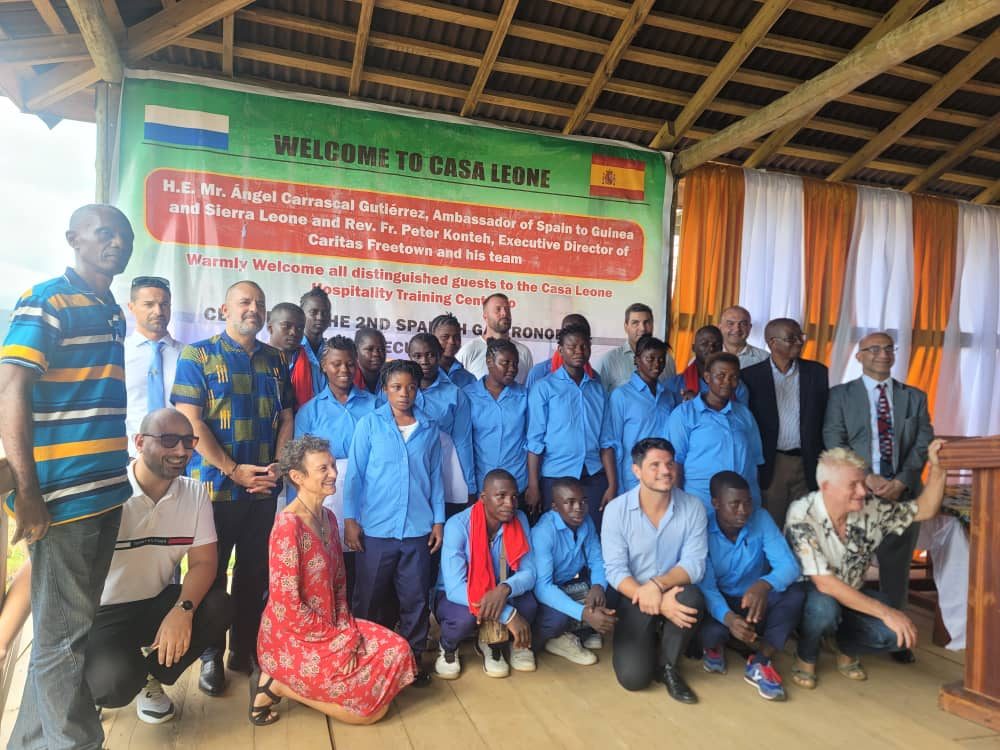
Caritas Freetown and the Ambassador of Spain to Guinea and Sierra Leone, H.E. Ángel Carrascal Gutiérrez, have celebrated the second Spanish Gastronomy and Food Security Meeting at the Casa Leone Hospitality Training Centre in Bureh Town, highlighting efforts to equip young Sierra Leoneans with practical hospitality skills and promote cultural exchange.
The event, held on October 15, 2026, brought together representatives of the Spanish, German and French Embassies, Caritas Freetown, the Ministry of Tourism and Cultural Affairs, project partners and trainees to celebrate the partnership behind the Casa Leone Hospitality Training Project, funded by Spain-based Fundación Maga.
Delivering the keynote address, Ambassador Ángel Carrascal Gutiérrez congratulated the trainees on their commitment and praised those who had completed the programme, describing Casa Leone as a piece of Spain in Freetown.
He said the project reflected Spain’s commitment to supporting Sierra Leone in areas including language, culture, food security and gastronomy, adding that the partnership had developed through engagements with Government officials and local partners since his first visit to Sierra Leone in 2024.
“Casa Leone is our baby and the fruit of our project,” he said, expressing appreciation to Caritas Freetown, Fundación Maga and other partners for contributing to the initiative.
The Ambassador, who described the event as part of a growing relationship between Spain and Sierra Leone, said he hopes the partnership would continue even in the absence of a resident Spanish Embassy in the country.
Speaking on the project’s achievements, Casa Leone Project Manager, Isatu Sidibay, said the initiative was established to equip young people aged 18 to 22 from communities across Sierra Leone with practical hospitality skills to improve their future employment opportunities.
She said the project provides six months of free hospitality training for young people who have the potential to succeed but face financial challenges.
According to Isatu Sidibay, the first batch of trainees graduated on May 15 and subsequently received opportunities to practice their skills in different hospitality settings.
She said the project is not only helping young people develop vocational skills but also creating opportunities for cultural exchange through the fusion of Spanish gastronomy and Sierra Leonean culinary traditions.
Isatu Sidibay disclosed that Casa Leone would soon open its hospitality training programme to members of the public, while its restaurant would also open to customers seeking to experience Spanish tapas prepared with locally available Sierra Leonean ingredients.
She also highlighted the contributions of the project’s international partners, congratulating Fundación Maga and its associated wine partner on their reported recognition in the wine tourism sector.
Representing Caritas Freetown Executive Director, Rev. Fr. Peter Konteh, Dr. Robert Moikowa said the project demonstrated how partnerships between the Catholic Church, development organisations and donors could complement Government efforts in human capital development.
He said the initiative aligned with the Government’s development priorities by providing young people with practical skills while supporting the tourism and hospitality sectors.
Robert Moikowa said the project’s importance extended beyond the activities taking place at the training centre, pointing to its contribution to communities and the broader national development agenda.
He thanked the partners for their continued support, noting that the collaboration had helped bring together organisations with a shared commitment to improving people’s lives.
Meanwhile, Abdul Malik Kamara, Senior Tourism Officer at the Ministry of Tourism and Cultural Affairs, welcomed the initiative, describing it as a positive contribution to the development of gastronomy tourism in Sierra Leone.
He said the Ministry is working to create an enabling environment for tourism through capacity building, infrastructure development, policy formulation and collaboration with public and private sector partners.
Abdul Malik Kamara recalled that Ministry representatives had attended Casa Leone in May to present certificates to graduating trainees, adding that the Ministry is willing to continue working with the project and other private sector initiatives to promote tourism.
He also highlighted the Ministry’s planned African regional tourism gastronomy event in December and the One Nation Reggae Festival scheduled for November as part of efforts to strengthen the country’s tourism sector.
Caritas Freetown Programmes Manager, Eliza Sillah, also outlined the organization’s broader work in supporting vulnerable communities, describing its mission as “love in action.”
She said Caritas Freetown’s interventions included healthcare, mental health rehabilitation, disaster response, protection against sexual and gender-based violence, access to justice and peacebuilding.
Eliza Sillah explained that the organization’s rehabilitation programme supports young people affected by substance use through a six-week rehabilitation process, followed by skills training and efforts to reunite them with their families.
She said such initiatives reflected Caritas Freetown’s wider commitment to restoring dignity and creating opportunities for vulnerable people.
The Casa Leone Hospitality Training Project forms part of ongoing efforts to develop local skills, promote cultural exchange and strengthen the link between vocational training and Sierra Leone’s tourism industry. https://thecalabashnewspaper.com/archives/65516

No comments:
Post a Comment