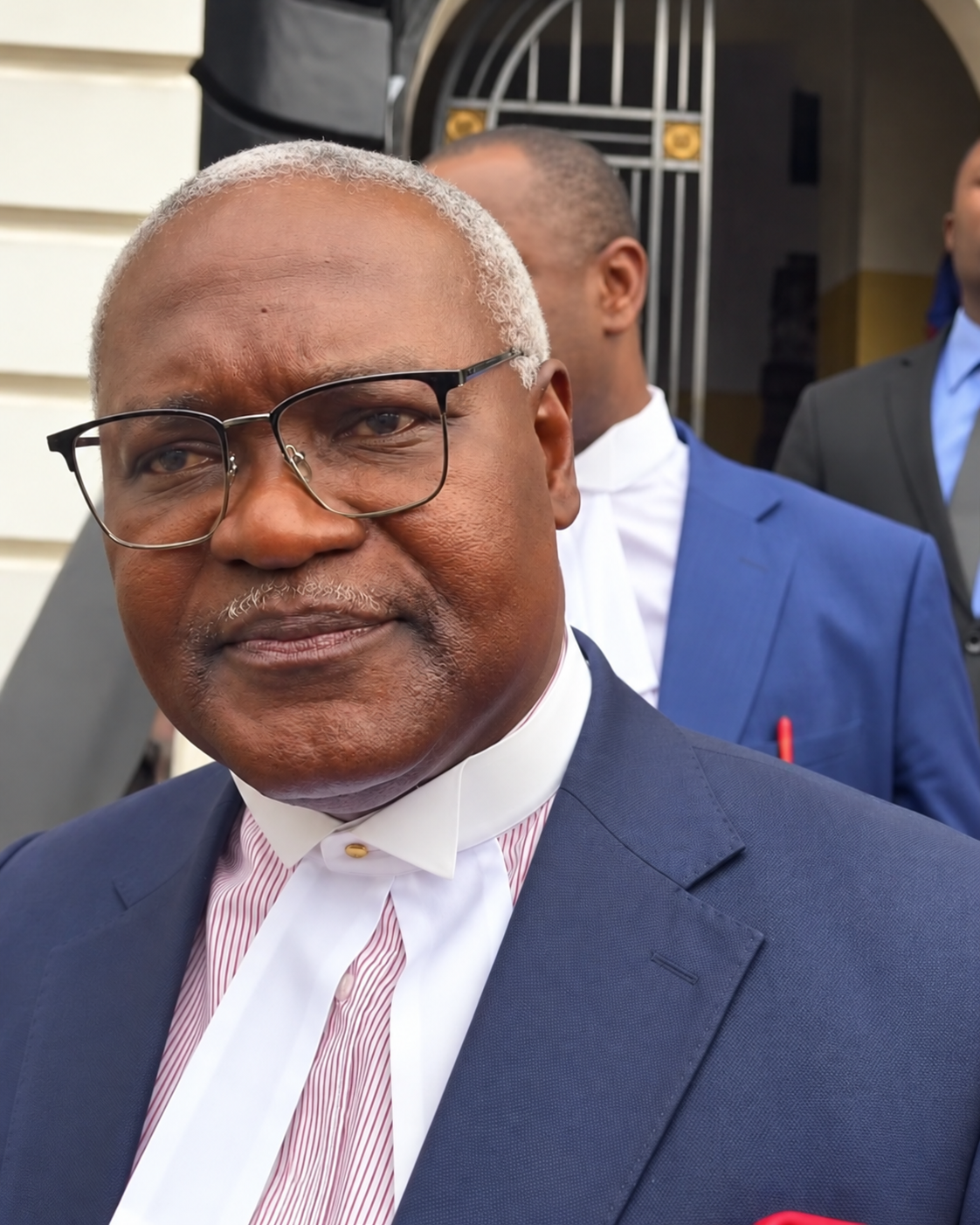
A constitutional matter before Sierra Leone’s Supreme Court took a dramatic turn on Thursday, October 8, 2026, when the Chief Justice and President of the Supreme Court, Honourable Justice Komba Kamanda, ordered prominent lawyer and former Attorney-General and Minister of Justice, Joseph Fitzgerald Kamara, popularly known as JFK, to be taken to Pademba Road Prison following a contempt of court ruling.
Lead Counsel for the All People’s Congress (APC), Joseph Fitzgerald Kamara (JFK), has been charged with contempt of court after he refused to comply with an order to withdraw a statement made during Wednesday’s proceedings.
Chief Justice Komba Kamanda ordered JFK to remove his wig and enter the dock after he declined to retract a statement.
The Court subsequently charged him with contempt.
Joseph Fitzgerald Kamara, who is representing the main opposition All People’s Congress (APC) in the ongoing constitutional proceedings, was ordered to remain in prison until Tuesday, October 13, 2026, despite tendering an apology to the Chief Justice and the Supreme Court over comments made during the previous day’s hearing.
The development followed a disagreement between the Chief Justice and the APC lawyer during proceedings on Wednesday, October 7, 2026, concerning documents submitted by the Attorney-General’s Office in the constitutional matter.
During the hearing, Joseph Fitzgerald Kamara reportedly challenged the procedural handling of the case, arguing that certain essential documents, including a Statement of Case, had not been properly filed by the Attorney-General’s Office.
The exchange subsequently developed into a confrontation over courtroom conduct, with the Chief Justice expressing serious concern about remarks attributed to the lawyer.
When proceedings resumed on Thursday, Chief Justice Komba Kamanda raised the issue and described some of the comments made during Wednesday’s sitting as “very, very degrading” towards the President of the Supreme Court.
The Chief Justice reportedly explained that he had deliberately avoided interrupting the previous day’s proceedings but considered it necessary to address the matter after becoming aware of a subsequent media interview in which Joseph Fitzgerald Kamara allegedly defended his conduct as acceptable within Sierra Leone’s adversarial legal system.
Justice Kamanda reminded counsel of the importance of maintaining respect for the judiciary, stressing that the Supreme Court is an independent institution established to uphold the Constitution and administer justice rather than serve as a platform for political confrontation.
He subsequently directed Joseph Fitzgerald Kamara to publicly apologize for his conduct or face contempt proceedings, including the possibility of restrictions on his appearance before the Supreme Court.
In response, the former Attorney-General tendered an apology to the Chief Justice and the Supreme Court, explaining that his actions had been motivated by his professional responsibility to defend his client and uphold the Constitution.
Despite the apology, the Chief Justice adjourned proceedings for approximately 15 minutes to allow the Court to consider the matter and determine its response.
Upon resumption, Justice Komba Kamanda delivered a ruling on the contempt issue and ordered Joseph Fitzgerald Kamara to remove his lawyer’s wig and enter the dock before later directing that he be escorted to Pademba Road Prison, where he was to remain until Tuesday.
The decision came despite the apology offered by the APC lawyer, making the proceedings a significant development in the ongoing constitutional matter.
As he was being escorted away, Joseph Fitzgerald Kamara reportedly turned towards fellow legal practitioners and declared, “Members of the Bar, I will be back.”
His remarks marked a dramatic conclusion to proceedings that had initially centred on constitutional arguments and procedural questions concerning documents filed before the Supreme Court.
The incident has also brought renewed attention to the relationship between the authority of the judiciary and the responsibility of legal practitioners to represent their clients vigorously while observing established standards of courtroom conduct.
Under Sierra Leone’s legal system, courts possess powers to address conduct considered contemptuous, particularly where such conduct is deemed to undermine judicial authority or interfere with the administration of justice. At the same time, lawyers are expected to advance their clients’ cases independently and within the boundaries of professional ethics and courtroom procedure.
The ruling represents a significant development for the APC’s legal representation in the constitutional proceedings, although its immediate implications for the continuation of the case remain unclear.
Further developments are expected when the matter returns before the Supreme Court, including clarification of Joseph Fitzgerald Kamara’s legal position and the next steps in the constitutional proceedings. https://thecalabashnewspaper.com/archives/65233

No comments:
Post a Comment