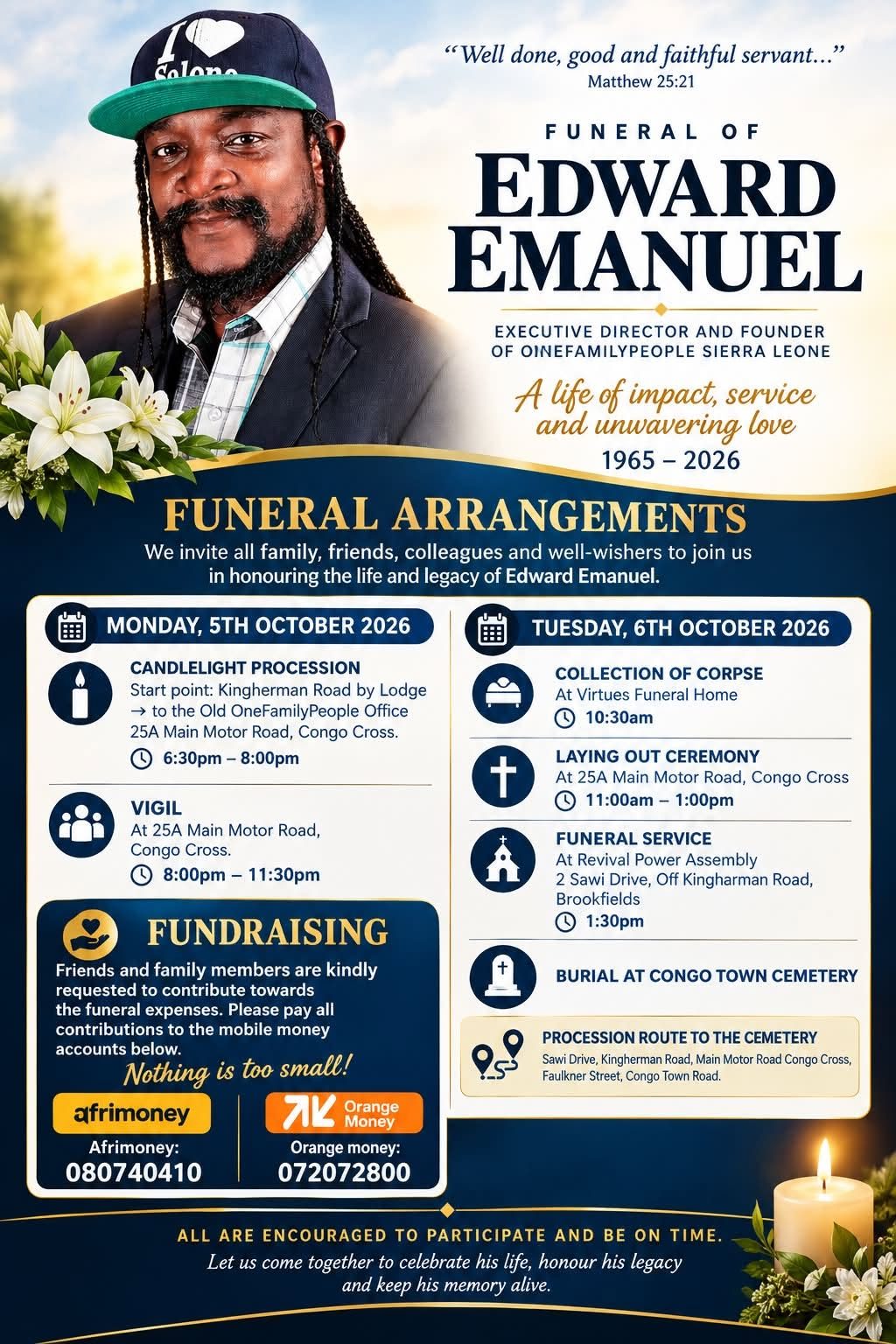
Sierra Leone’s disability community has lost more than an advocate. It has lost a friend, mentor, organizer, campaigner and champion who spent more than two decades challenging the exclusion of some of the country’s most vulnerable citizens.
The late Edward Emmanuel, Founder and Executive Director of One Family People (OFP), devoted his life to creating opportunities for persons with disabilities, street-connected children and other vulnerable people who were too often ignored, marginalized or forced to survive on the streets.
Through One Family People, Edward helped build a movement founded on a simple but powerful conviction: persons with disabilities should not be treated as objects of charity, but as people with rights, talents, aspirations and the capacity to contribute to society.
His death has therefore left a profound void, but the tributes from colleagues, international partners, disability-rights advocates, beneficiaries and friends demonstrate that his influence extends far beyond the organisation he founded.
The Residual Special Court for Sierra Leone, in a tribute during funeral service held on Tuesday 6th October, 2026 at the Let My Gate Be Opened - Solution Cathedral also known as the Revival Power Assembly, recalled Edward's involvement with the Special Court's Outreach programme, noting that he first came to the Court in 2004 and developed a relationship with its outreach activities from 2007.
At the time, Edward was working with street-connected children. By 2008, he had registered One Family People and expanded his advocacy to persons with disabilities, including deaf people and, subsequently, children and young people with autism.
The Residual Special Court recalled that many people with disabilities had been pushed to the margins of society, with some becoming homeless or being forced to beg for a living.
Edward's response was not simply to speak about their plight. He went to where they were.
He reportedly spent nights with vulnerable people who were sleeping in an abandoned bus station because he wanted to understand their circumstances from their perspective.
That willingness to experience the conditions faced by the people he served became one of the defining characteristics of his advocacy.
The Residual Special Court described him as someone whose life was dedicated to persons with disabilities, remembering his sincerity, work ethic, religious convictions, generosity, humility and dependable friendship.
According to Hadiatou Diallo, Co-founder of One Family People and Edward's life partner, their journey of service emerged from difficult years on Walpole Street.
From that experience came One Family People and The Great Walpoleans, creating opportunities, community and a voice for children and young people with disabilities.
One Family People subsequently developed into a disability-focused human-rights organisation working on inclusion, advocacy, capacity building, partnerships and resource mobilisation.
The organization’s own records demonstrate the scale of the work Edward helped lead. Over the years, One Family People allocated billions of Leones to partner organisations, including the Dorothy Springer Trust, Kono Cheshire Services, Disability Awareness Action Group, Welfare Society for the Disabled, Polio Persons Development Association and Sierra Leone Autistic Society in order to support children with disabilities in health, education, livelihoods and social inclusion.
These supports demonstrate that Edward's vision was not confined to Freetown. He helped establish partnerships through which disability-support initiatives could reach communities in different parts of Sierra Leone.
Perhaps one of the clearest descriptions of Edward's philosophy comes from his former colleague Francis Kabia.
Kabia recalled Edward's mantra:
“We should not give persons with disabilities fish; we must teach them how to fish and stand by them every step of the way.”
That philosophy captures the difference between charity and empowerment.
Edward understood that giving temporary assistance could address an immediate need, but creating sustainable change required helping people acquire skills, find opportunities, earn livelihoods and participate meaningfully in society.
This philosophy was reflected in One Family People's work in education, livelihoods, healthcare, social inclusion and advocacy.
In 2022, Edward told beneficiaries and partners that One Family People believed persons with disabilities were “powerful, radiant agents of change”, and that the organisation was committed to listening to them, giving them space to shine and working with them to find solutions that benefited individuals, families and communities.
One of Edward's most distinctive contributions was his recognition of music, dance and drama as tools for inclusion and empowerment.
The Great Walpoleans became more than an entertainment group. It became a platform through which people with disabilities could demonstrate their abilities and challenge assumptions about what they could achieve.
The Residual Special Court recalled adults with disabilities performing skits on justice and human rights, while deaf young people danced to music during activities connected to the Court's outreach programme.
The group's members, Sallay and Alafi, remembered Edward as someone who saw their talent when others saw only limitations.
They said he nurtured their potential through music, dance and drama, teaching them to believe in themselves, speak for themselves and refuse to allow disability to define their destiny.
That may be one of Edward's greatest achievements: he helped change the narrative from “What can a person with a disability receive?” to “What can a person with a disability contribute?”
Edward's advocacy also contributed to broader disability-rights conversations in Sierra Leone.
Former Human Rights Commission of Sierra Leone Chairperson and Commissioner Jamesina E. L. King described him as a determined and courageous advocate who insisted that persons with disabilities be heard, respected and treated with dignity.
She specifically recognized his contribution to disability-rights advocacy, including the movement that contributed to the Persons with Disabilities Act, 2011.
His advocacy was therefore part of a wider national struggle to move disability from the margins of social welfare into the arena of rights, accountability and public policy.
One Family People's work has also involved engagement with government institutions. In 2021, for example, the organisation engaged the National Disaster Management Agency on ensuring that the needs and voices of persons with disabilities were incorporated into disaster preparedness and response. Edward argued that inclusion at the planning and preparedness stages could reduce vulnerability and improve government response and recovery.
The programmes he led supported children with disabilities in education, health, livelihoods and social inclusion. The organisation also worked with parents and caregivers to strengthen their ability to support children with disabilities.
His commitment was particularly visible in his work with children with autism.
Mary Pentimity, Co-founder, CEO, and Executive Director, Sierra Leone Autistic Society remembered Edward as a trusted friend, brother and fierce ally in building the organisation.
She recalled how he took advocacy beyond formal meetings, bringing music, dance, joy and confidence into classrooms and youth clubs, helping create spaces where children with autism could be celebrated rather than pitied.
That work was part of a broader effort to challenge stigma and promote acceptance.
The United Nations in Sierra Leone also documented Edward's engagement with children at the Mahanaiem Rehabilitation Centre in Grafton. During a March 2025 visit by UN Resident Coordinator Seraphine Wakana, Edward said the children demonstrated courage and strength that was deeply inspiring.
The sensory room: a physical legacy of inclusion
One of the final major achievements associated with Edward's leadership was the opening in May 2025 of what The Calabash described as Sierra Leone's first sensory room for children with severe and multiple disabilities.
The facility, opened in Grafton, provides a specialised environment where children with complex disabilities can play, express themselves and develop cognitive, emotional and motor skills.
Edward described the facility as a symbol of love, inclusion and belief in the abilities of every child. The project had been developed over several years with support from partners including Liliane Fonds, Miva, Il Giardino di Ngali2, the Champions Club of Sierra Leone and the Ministry of Social Welfare.
The significance of the sensory room goes beyond the physical facility.
It reflects the philosophy Edward spent years promoting: that children with disabilities deserve spaces designed around their needs, abilities and potential.
Edward's influence was also visible in his ability to bring people and organisations together.
One Family People worked with national disability organisations, government institutions, international development partners and community-based organisations.
Its 2015 annual report listed a wide network of partner organisations and strategic partners, reflecting an approach based on collaboration rather than isolation.
The organization’s programmes have subsequently continued to expand. In 2025, One Family People launched the Programme for Inclusion and Empowerment, a multi-year initiative focused on children and young people with disabilities.
This continuity is important because it suggests that Edward's greatest institutional achievement may not have been a single project, but the creation of a structure capable of continuing the work after his passing.
One of the most striking themes in the tributes is Edward's refusal to accept exclusion.
Sandra Emons described him as one of the most inspiring and creative people she had met through her work for humanity and inclusion. She recalled that he asked persons with disabilities what they needed and what they wanted to do and then helped them pursue those goals.
She also remembered his refusal to remain in a hotel when she and another colleague, Wizzard, were refused accommodation.
For Emons, that moment captured Edward's character: he would not accept privileges for himself while people he stood with were being excluded.
The ICDI team similarly described him as an activist “through and through” energetic, committed and unwilling to regard problems as insurmountable.
They remembered him as equally comfortable on the streets of Freetown and in boardrooms, with a song for every occasion.
That combination of activism, humour, creativity and compassion appears repeatedly throughout the tributes.
Beyond the public work, Edward's legacy was deeply personal.
Kumba Mattia remembered him as someone who became more than a friend, he became a son to her. She recalled how he embraced her son, Foday, supported his education and stood beside the family during difficult times.
Dr. Abs Dumbuya, Founder & CEO of the Dorothy Springer Trust and family described him as a compassionate and courageous champion for children and young people with disabilities who opened doors to dignity, inclusion and opportunity.
Diana Szántó remembered him as a visionary disability-rights advocate, but also as a friend, protector, brother and son whose music, laughter and compassion created spaces of joy and belonging.
And for Samuel P. O. V. Macauley, Director of Operations and Programmes at One Family People, Edward was more than a founder and executive director. He was a leader, mentor, brother and source of inspiration.
Macauley said Edward taught the organisation that its work was not simply about programmes and projects, but about people, dignity, inclusion and changing lives.
That may be the most important measure of his legacy.
Edward's work did not end with the programmes he had completed.
According to Sulaiman Jabati, shortly before his passing Edward shared a vision for a solar project that could create jobs and opportunities for persons with disabilities.
It was another expression of his lifelong belief that inclusion must translate into economic opportunity and independence.
His unfinished dreams now belong to those he inspired.
Edward Emmanuel's life cannot be reduced to the title of Founder and Executive Director of One Family People.
He was a bridge between people who were often excluded and institutions that had the power to create change.
He connected disability advocacy with human rights, entertainment with empowerment, compassion with practical action, and vulnerable communities with opportunities.
His record includes advocacy, employment support, housing assistance, education, healthcare, livelihoods, community mobilisation, research, disaster preparedness, disability awareness and specialised services for children.
But the strongest testimony to his life comes from the people themselves.
The Great Walpoleans say he taught them to believe in themselves.
The Sierra Leone Autistic Society says he helped create spaces where children could be celebrated rather than pitied.
His colleagues remember a leader who challenged them to think bigger and serve better.
International partners remember an activist whose energy and determination were difficult to match.
And the disability movement remembers a man who insisted that people with disabilities must be heard, respected and given opportunities to determine their own futures.
Edward's death therefore marks the end of a life, but not the end of the work.
His greatest legacy is the people he empowered to stand.
The children who gained opportunities.
The young people who discovered their talents.
The persons with disabilities who found a voice.
The families who found hope.
The organisations that became stronger.
And the advocates who learned that inclusion is not a favour it is a right.
As Hadiatou Diallo, Co-Founder One Family People and Life Partner, reflected, Edward's greatest legacy is not simply what he built, but the people he believed in, encouraged and empowered.
That is a legacy that cannot easily die.
A final tribute
Edward Emmanuel spent his life trying to ensure that those society had pushed aside would no longer remain invisible.
He stood with people sleeping on streets.
He advocated for people with disabilities.
He helped create employment and livelihood opportunities.
He used music, dance and drama to restore confidence.
He fought stigma.
He supported children with autism.
He helped build organisations and partnerships.
He challenged institutions.
He dreamed of new opportunities for persons with disabilities even while facing serious illness.
And, according to those who knew him, he did much of it with a smile, a song, a characteristic hat and an unwavering belief in humanity.
The Residual Special Court recalled that Edward often ended conversations by saying:
“God bless you and God be with you always.”
For a man who devoted his life to ensuring that others were not forgotten, perhaps the most fitting tribute is that Sierra Leone must not forget him or the people for whom he spent his life fighting.
Edward Emmanuel may be gone, but the movement he helped strengthen continues. His voice may be silent, but the people he empowered continue to speak.
May his soul rest in perfect peace. https://thecalabashnewspaper.com/archives/65181

No comments:
Post a Comment