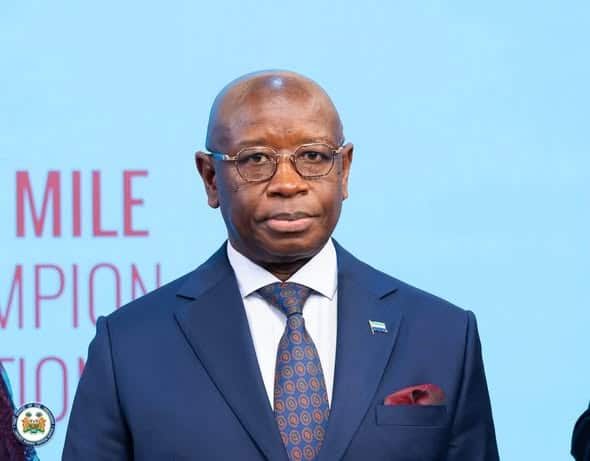
President Dr. Julius Maada Bio has announced that Sierra Leone will increase its contribution to the International Fund for Agricultural Development’s Fourteenth Replenishment, known as IFAD14, by at least 50 percent, as part of efforts to strengthen food security, agricultural production, rural livelihoods and employment opportunities.
The commitment was announced during the IFAD14 African Leadership Moment at the Goals Lounge, United Nations Headquarters in New York, on Friday, 25 September 2026, where African leaders highlighted the importance of greater investment in rural communities and food systems.
Sierra Leone is among ten African countries that announced increased contributions to IFAD14, collectively pledging nearly US$9 million towards the Fund’s 2028-2030 replenishment cycle. The other participating countries are Burundi, Chad, Ethiopia, Guinea, Kenya, Rwanda, Somalia, Sudan and Zimbabwe.
Some of the participating countries have more than tripled their previous contributions, while the largest increases are reported to be almost ten times earlier commitments. The initiative reflects efforts by African Governments to demonstrate greater domestic commitment to agricultural and rural development while encouraging international partners to increase their support.
Addressing the gathering, President Julius Maada Bio described agriculture as fundamental to Sierra Leone’s economic and social development, stressing that investment in the sector is essential to improving livelihoods and securing the country’s food supply.
“Agriculture is more than a sector for Sierra Leone. It is the foundation of our food security, our livelihoods and our future,” he said.
The President placed particular emphasis on rural communities, arguing that they should not be regarded merely as the final beneficiaries of development programmes. He said they represent the starting point for food production and remain central to Sierra Leone’s development aspirations.
“Rural areas are often called the last mile. In Sierra Leone, they are the first mile, where most of our people live and work, and where food security begins,” President Julius Maada Bio stated.
Highlighting Sierra Leone’s longstanding relationship with IFAD, he noted that the institution has supported the country for more than four decades. He said the Government has sought to complement that international partnership by increasing domestic investment in agriculture.
According to figures presented by the President, agriculture’s share of Sierra Leone’s national budget has risen from 2 percent to 8 percent within two years. He also reported that rice self-sufficiency increased from 68 percent in 2019 to 73 percent.
Against that background, President Julius Maada Bio confirmed that Sierra Leone’s contribution under IFAD14 would be increased by at least 50 percent compared with its contribution during IFAD13. The additional commitment, he said, will be financed through the national budget.
The pledge forms part of the Government’s stated determination to strengthen agricultural productivity and improve opportunities for farmers and rural communities. President Julius Maada Bio maintained that meaningful transformation of food systems requires direct investment in the people responsible for producing food.
“If we want to transform food systems and create jobs, we must invest in the people who produce our food,” he said.
He also called on development partners and other stakeholders involved in the IFAD replenishment process to respond with stronger commitments to agricultural development.
“Sierra Leone is doing its part. I invite every partner here to do the same,” he added.
President of IFAD , Alvaro Lario, welcomed the increased commitments from African countries, describing IFAD14 as an important platform for strengthening agrifood systems across the continent.
According to Alvaro Lario, nearly 60 percent of IFAD’s portfolio is invested in Africa, with the Fund concentrating considerable attention on the “first mile” of food systems, where investments can support employment, resilience and inclusive economic growth.
IFAD’s financing model combines contributions from member states with loan repayments, borrowed resources and co-financing. Through this arrangement, the institution says every dollar contributed to its core resources can generate approximately six dollars in investment.
The Fund, which holds an AA+ credit rating, has also issued more than US$1 billion in sustainable bonds since 2022 to mobilize additional financing for small-scale farmers, rural enterprises and climate-resilient food systems.
For Sierra Leone, the increased IFAD14 contribution comes amid broader efforts to place agriculture at the centre of national development, particularly through increased food production, investment in farming and efforts to reduce dependence on food imports.
The commitment also places the country within a wider African initiative to demonstrate greater ownership of rural transformation. By increasing their own contributions, participating Governments are seeking to encourage development partners and international financial institutions to provide additional resources for agricultural development.
President Julius Maada Bio stressed that improving food security cannot be separated from the welfare of farmers and rural communities, particularly those responsible for producing much of the food consumed across the country.
Sierra Leone’s increased contribution therefore represents both a financial commitment to IFAD and a reaffirmation of the Government’s stated position that sustainable agricultural transformation must begin with investment in farmers, producers and communities at the centre of the food system.
The collective commitment announced by the ten African countries also sends a broader message ahead of the IFAD14 replenishment period: African Governments are increasing their own investments while calling on international partners to match that ambition with greater financing for rural development, food security and resilient agricultural systems. https://thecalabashnewspaper.com/archives/64927

No comments:
Post a Comment