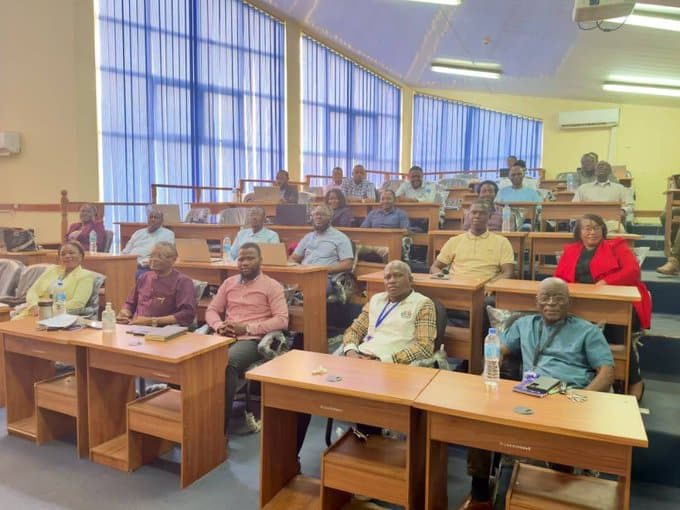
The Sierra Leone Civil Aviation Authority (SLCAA) has held a two-day Safety Management and Occurrence Reporting Workshop aimed at strengthening aviation safety, improving risk management and promoting the timely reporting of safety-related occurrences.
The workshop brought together representatives from the Sierra Leone Civil Aviation Authority, Sierra Leone Airports Authority, Sierra Leone Handling Partners, Freetown International Airport and Roberts Flight Information Region. Their participation reflects the importance of cooperation among regulators, airport operators, ground-handling companies and air-navigation service providers in maintaining a safe aviation system.
Director General of the Sierra Leone Civil Aviation Authority, Musayeroh Barrie, said the engagement forms part of the institution’s commitment to strengthening proactive safety management, effective risk control and timely occurrence reporting across the aviation sector.
Musayeroh Barrie explained that the workshop provides an opportunity for participating institutions to deepen their understanding of aviation hazards, assess operational risks and strengthen the procedures used to report and address safety concerns.
According to Musayeroh Barrie, collaboration among the participating institutions is essential to building a stronger safety culture and ensuring safer skies in Sierra Leone.
Discussions during the workshop focused on hazard identification, risk assessment, incident prevention, safety-data collection and the proper documentation and analysis of operational occurrences. Participants also examined how improved information-sharing can help aviation institutions identify potential dangers and introduce corrective measures before they develop into serious incidents or accidents.
Occurrence reporting is an important component of aviation safety management because it enables regulators and service providers to collect information about incidents, operational irregularities and potentially unsafe conditions. The information gathered can be analyzed to identify recurring problems, emerging risks and areas requiring corrective action.
The workshop also promoted the principle of a “just culture,” which encourages aviation personnel to report genuine safety concerns without fear of unfair punishment, while maintaining accountability for deliberate misconduct or serious violations of established procedures.
An effective Safety Management System requires aviation institutions to establish clear responsibilities, develop safety policies, introduce risk-control measures and continuously monitor their safety performance. It also encourages organisations to move beyond reacting to accidents by identifying and managing risks before they cause harm.
The engagement supports Sierra Leone’s State Safety Programme, which provides a framework for regulating and managing aviation safety in accordance with International Civil Aviation Organization standards. Under the framework, the Sierra Leone Civil Aviation Authority exercises regulatory oversight, while aviation service providers are expected to establish and maintain effective Safety Management Systems.
The participation of Roberts Flight Information Region was particularly important because aviation safety requires coordination beyond individual airports and national institutions. Effective cooperation in airspace management, occurrence reporting and the exchange of safety information can help reduce risks across interconnected aviation operations.
By bringing the institutions together, the two-day workshop strengthened shared responsibility, institutional coordination and risk-based decision-making within Sierra Leone’s aviation industry.
The initiative demonstrates the Sierra Leone Civil Aviation Authority’s continued commitment to protecting passengers, aviation personnel and the wider public while promoting safer airport operations and more secure skies across the country. https://thecalabashnewspaper.com/archives/64804

No comments:
Post a Comment