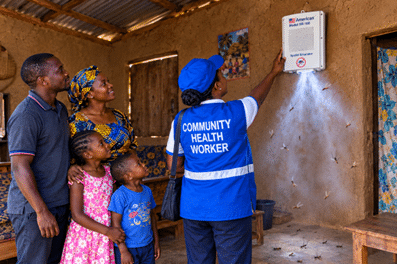
The Ministry of Health, through the National Malaria Control Programme and its partners, will deploy 101,862 Spatial Emanators in selected communities in Bonthe and Tonkolili districts as part of efforts to strengthen household protection against malaria.
The deployment, scheduled for October 6 to 20, 2026, will cover Sittia and Dema chiefdoms and Bonthe Municipality in Bonthe District, as well as Yoni Mabanta and Poli chiefdoms in Tonkolili District.
Supported by the United States Government, the initiative represents another major step in Sierra Leone’s fight against malaria by taking preventive technology directly to households, including families living far from health facilities.
Spatial Emanators are malaria-prevention devices designed to slowly release insecticide into the surrounding environment. The insecticide kills or weakens mosquitoes and reduces their ability to settle and bite people, thereby lowering the risk of malaria transmission.
Trained Community Health Workers and other authorized personnel will move from house to house during the deployment period to install the devices in eligible households.
Beyond installation, the health workers will explain what the devices are, how they function, where they should be placed and how they complement other malaria-prevention measures. Community education and acceptance will be essential to the success of the intervention.
The Ministry of Health has emphasized that Spatial Emanators are not intended to replace insecticide-treated mosquito nets, Indoor Residual Spraying, preventive medicines, malaria vaccination or other recommended interventions.
Instead, the devices will provide an additional layer of protection for families, particularly children under five, pregnant women and residents of communities with limited access to health services.
Malaria remains one of Sierra Leone’s most serious public-health challenges. According to the World Health Organization’s 2025 Sierra Leone malaria country profile, more than eight million people were living in high-transmission areas in 2024.
During that year, Sierra Leone recorded approximately two million presumed and confirmed malaria cases, including about 1.9 million confirmed cases, and nearly 2,500 reported deaths.
WHO estimates placed the country’s malaria burden even higher, at approximately 2.4 million cases and 6,600 deaths. Despite the continuing threat, the country has recorded encouraging progress. Reported malaria cases declined by approximately 14 per cent in 2024 to about 2,023,764 cases, while the annual malaria parasite incidence stood at approximately 213 cases per 1,000 people.
The figures indicate that Sierra Leone is moving in the right direction, although sustained action will be required to significantly reduce infections and deaths.
For decades, the country’s malaria response has relied on a combination of interventions, including the distribution of insecticide-treated mosquito nets, Indoor Residual Spraying and preventive treatment using Sulfadoxine-Pyrimethamine for pregnant women. Preventive treatment for infants has also been introduced.
The country has simultaneously strengthened malaria testing, treatment, community-based healthcare services and public awareness programmes aimed at encouraging people to adopt effective preventive practices.
Sierra Leone introduced the malaria vaccine for young children in 2024, adding another important tool to its national malaria-prevention package. The introduction of Spatial Emanators will further broaden the range of measures available to protect vulnerable families.
Residents in the targeted communities will continue to be encouraged to sleep under insecticide-treated mosquito nets every night and follow all other recommended malaria-prevention measures.
For households in Bonthe and Tonkolili, the distribution of more than 101,000 Spatial Emanators represents an important public-health milestone and a renewed message of hope.
Although technology alone cannot eliminate malaria, the combination of strong Government leadership, committed healthcare workers, supportive development partners and well-informed communities can accelerate progress.
Every mosquito bite prevented matters, every child and pregnant woman protected matters, and every household reached takes Sierra Leone another step closer to a future where malaria is no longer a routine threat to families.
https://thecalabashnewspaper.com/archives/64301

No comments:
Post a Comment