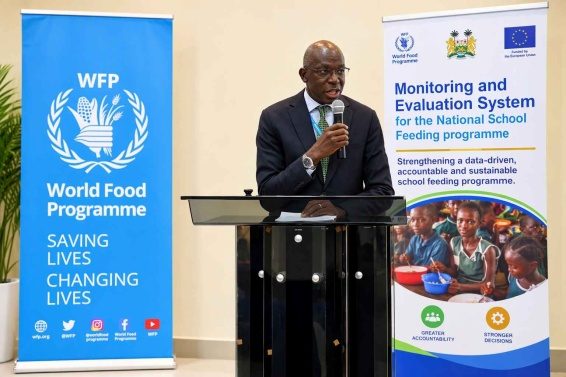
The Ministry of Basic and Senior Secondary Education (MBSSE), in collaboration with the European Union (EU) and the United Nations World Food Programme (WFP), has unveiled a €2 million initiative designed to improve monitoring, transparency, accountability and evidence-based management of Sierra Leone’s National School Feeding Programme.
The two-year intervention, financed by the European Union and implemented with technical support from WFP, seeks to strengthen the Government’s institutional capacity to collect, analyse and utilize reliable information in managing school feeding activities nationwide.
The initiative is expected to contribute to improved school feeding services for more than one million children across Sierra Leone, while ensuring that resources are effectively allocated and programme implementation is guided by accurate and timely information.
The official launch took place on Monday, 9 November 2026, during an inception meeting at the New Brookfields Hotel in Freetown. The gathering attracted senior representatives from MBSSE, the National School Feeding Secretariat, the European Union, WFP, relevant Government institutions, district education authorities and development partners.
The intervention comes amid growing efforts by the Government to expand the National School Feeding Programme, which remains an important component of the country's education and social protection agenda.
With increasing numbers of schoolchildren benefiting from the programme, stakeholders have recognised the need for stronger monitoring mechanisms capable of tracking implementation, assessing performance and identifying operational challenges.
Existing monitoring arrangements depend considerably on manual reporting procedures and fragmented data-collection systems, creating difficulties in accessing comprehensive and timely information for effective planning and decision-making.
The newly launched initiative is therefore expected to address those shortcomings through improved monitoring and evaluation systems, stronger data-quality assurance mechanisms, enhanced reporting procedures and the introduction of digital technologies.
Among the technological solutions to be deployed are Open Data Kit and School Connect, which will facilitate real-time information gathering, strengthen data management and support faster, evidence-based decisions.
The intervention will also prioritize Government ownership, institutional sustainability and capacity development to ensure that national authorities can independently manage and utilize the improved monitoring systems beyond the project's implementation period.
Delivering his statement at the launch, the Minister of Basic and Senior Secondary Education, Conrad Sackey, described the initiative as an important step towards transforming the management and oversight of the National School Feeding Programme.
He explained that over the next 24 months, with financial assistance from the European Union and technical expertise from WFP, the National School Feeding Secretariat would transition from merely recording activities to systematically managing evidence that informs policy and operational decisions.
“Strengthening our monitoring and evaluation system will enable us to better understand what is working, identify gaps and ensure that resources reach the children and schools that need them. This initiative will help us make decisions based on reliable evidence and strengthen accountability across the programme,” the Minister stated.
Conrad Sackey emphasized the importance of building a monitoring framework that goes beyond documenting the number of meals served or schools covered, focusing instead on measuring programme effectiveness and identifying areas requiring improvement.
Representing the European Union, Abdul Deen Sesay reaffirmed the EU's commitment to supporting Sierra Leone's education sector through investments that promote institutional efficiency, accountability and sustainable programme delivery.
“The European Union is pleased to support this initiative through the provision of Euros 2 million to the WFP to strengthen the M &E system of the School Feeding Secretariat in terms of improving the tools, processes, capacity and information system that enables more effective management and oversight of the school feeding programme,” he stated.
The EU's financial contribution will support improvements in monitoring tools, reporting processes, institutional capacity and information systems, enabling the National School Feeding Secretariat to exercise stronger oversight of school feeding operations.
For its part, WFP will provide technical assistance and work closely with Government institutions and development partners to establish a more coordinated and comprehensive monitoring and evaluation framework.
Speaking during the engagement, WFP Representative and Country Director, Andrew Odero, underscored the importance of developing an integrated system that combines digital technology, common reporting standards, field-level capacity building and community participation.
“This initiative will support the Government in developing a comprehensive monitoring and evaluation system for the National school feeding programme, bringing together common standards, digital monitoring tools, stronger field-level capacity and mechanisms for community feedback,” he said.
Andrew Odero further explained that the intervention would strengthen the National School Feeding Secretariat's ability to consolidate information from different implementation levels and translate the findings into practical decisions.
The inception meeting also provided a platform for participating institutions to examine the proposed monitoring and evaluation framework, define their respective responsibilities and identify immediate priorities for implementation.
Stakeholders are expected to agree on coordinated approaches that would improve information sharing, strengthen institutional collaboration and ensure effective implementation throughout the two-year period.
Beyond the introduction of digital monitoring platforms, the initiative will focus on developing the technical competencies of personnel responsible for collecting, verifying, analyzing and reporting programme information.
This institutional strengthening component is considered essential to ensuring that the improved systems become part of routine programme management rather than remaining dependent on external technical assistance.
The incorporation of community feedback mechanisms is also expected to create additional opportunities for parents, school authorities and local stakeholders to contribute to programme oversight and identify challenges affecting school feeding delivery.
By improving the availability and reliability of information, the partnership aims to enable decision-makers to respond more effectively to operational difficulties, address implementation gaps and promote greater transparency in the utilization of resources.
The initiative represents another significant collaboration between the Government of Sierra Leone, the European Union and WFP in strengthening education-related social protection interventions.
As the National School Feeding Programme continues to expand, the success of the intervention will depend not only on the introduction of new technologies but also on the ability of national institutions to consistently generate reliable data and use it to improve service delivery.
Ultimately, the €2 million investment is intended to establish a stronger foundation for accountable, transparent and evidence-driven school feeding management, helping ensure that the programme delivers meaningful and sustainable benefits to schoolchildren across Sierra Leone. https://thecalabashnewspaper.com/archives/66111

No comments:
Post a Comment