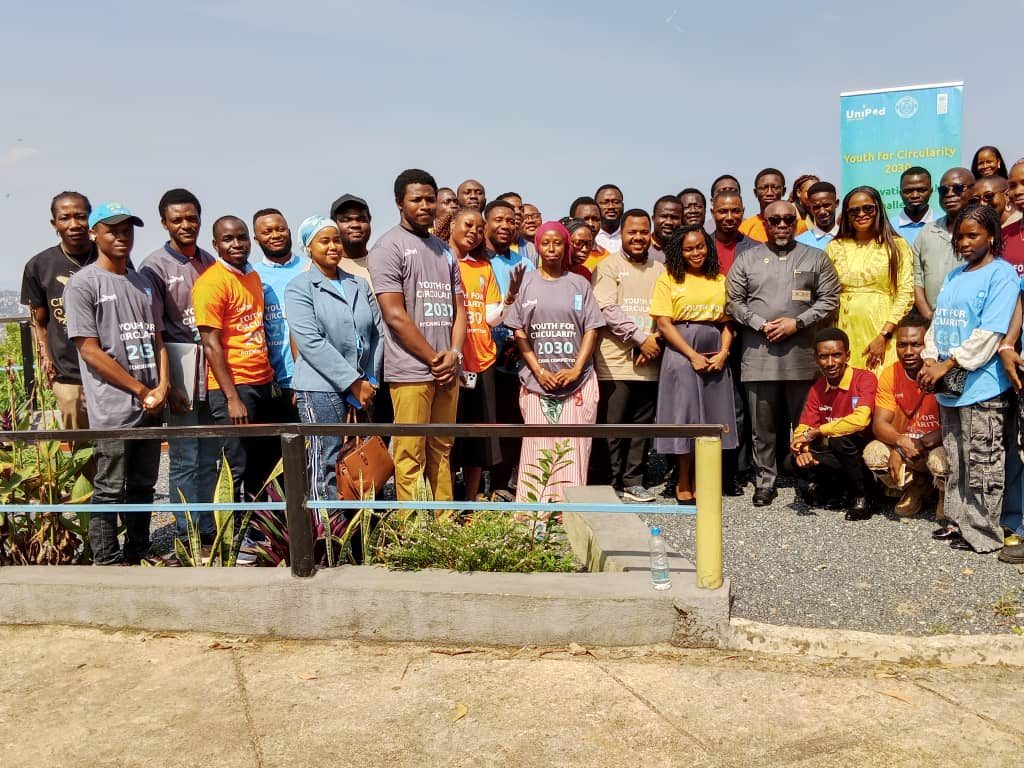
Seventeen youth-led teams showcased innovative solutions to Sierra Leone’s growing electronic waste challenge during the Youth for Circularity 2030 Innovation Challenge held on Thursday, November 5, 2026, at the University Innovation Pod (UniPod), Fourah Bay College, University of Sierra Leone.
Organized under the United Nations Development Programme (UNDP) Sierra Leone’s Youth for Circularity 2030 initiative, the competition brought together Government officials, academics, development partners and young entrepreneurs to explore sustainable approaches to electronic waste management while creating economic opportunities for young people.
The event attracted prominent personalities, including UNDP Sierra Leone Country Representative, Fredrick Ampiah; Minister of Technical and Higher Education, Dr. Haja Ramatulai Wurie; and Vice-Chancellor of Fourah Bay College, Professor Andrew Baio.
Addressing participants, Fredrick Ampiah commended the young innovators for developing practical solutions to environmental challenges. He emphasized that the competition was intended to encourage innovations capable of contributing meaningfully to community development and economic transformation.
“I want to see those solutions that can contribute to national and community development,” he stated.
Fredrick Ampiah disclosed that finalists would receive laptops and other essential devices to strengthen their technological capabilities and support the development of their innovations.
Delivering the keynote address, Minister of Technical and Higher Education, Dr. Haja Ramatulai Wurie, commended UNDP Sierra Leone, Samsung Electronics and the University of Sierra Leone for providing young people with opportunities to demonstrate creativity and entrepreneurial potential.
She emphasized the importance of integrating technological innovation, practical education and entrepreneurship into higher education, noting that discarded electronic devices could become valuable economic resources through responsible recycling and reuse.
“Young people cannot do this alone. Government has a role to play to develop policies and create more opportunities, especially for women,” Dr. Haja Ramatulai Wurie stated.
She encouraged stronger collaboration among Government institutions, universities and development partners to transform promising innovations into sustainable businesses.
Vice-Chancellor of Fourah Bay College, Professor Andrew Baio, reaffirmed the university’s commitment to promoting research, experimentation and practical innovation.
“Experiment is a key part of this process,” he said, encouraging participants to develop solutions that address real community challenges.
Speaking to The Calabash Newspaper, Winifred Doe of Female Innovation Lab introduced an initiative titled “Second Life Tech,” designed to empower women to repurpose discarded mobile phone components into creative and educational materials.
She explained that the project also seeks to educate women about electronic waste hazards while developing practical recycling skills.
The competition attracted 39 concept submissions, of which 29 satisfied eligibility requirements. Following technical assessments, 17 teams qualified to present their innovations before a panel of experts.
The proposed solutions focused on repairing, refurbishing, reusing and responsibly recycling discarded mobile electronic devices.
Promising concepts will be considered for further incubation, technical assistance and prototyping support.
The initiative has also supported Circular Innovation Clubs across four universities, promoting environmental awareness, sustainable consumption and entrepreneurship.
Through these interventions, UNDP Sierra Leone and its partners aim to strengthen youth participation in the circular economy while transforming electronic waste into opportunities for innovation, employment and sustainable national development. https://thecalabashnewspaper.com/archives/66003

No comments:
Post a Comment