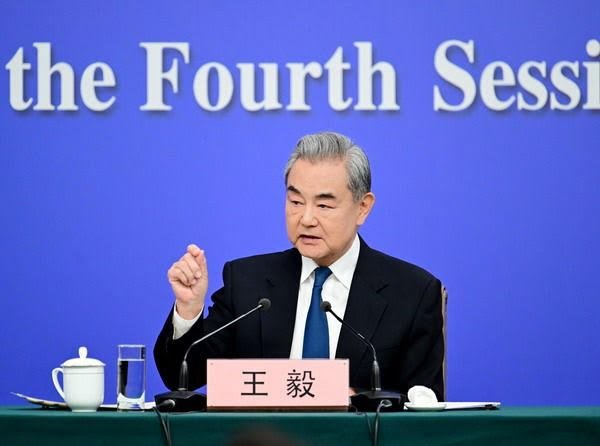
China’s Foreign Minister, Wang Yi, has called for an immediate ceasefire and renewed diplomatic engagement to address rising global tensions, particularly the escalating conflict in the Middle East, while reaffirming China’s commitment to multilateral cooperation and global stability.
Speaking during a press conference on the sidelines of the Fourth Session of the 14th National People’s Congress in Beijing on March 8, 2026, Wang Yi responded to questions from Chinese and international journalists on China’s foreign policy priorities and key international developments. 
At the beginning of the briefing, Wang Yi extended greetings to women around the world in recognition of International Women’s Day, while also acknowledging the role of the media and the wider international community in engaging with China’s diplomatic efforts.
He noted that the international system is currently undergoing profound changes, describing the global landscape as one marked by “transformation and turbulence,” with conflicts and geopolitical tensions continuing to flare up in several regions. Despite these challenges, he emphasized that China remains confident in its development trajectory and its role in contributing to international peace and stability. 
According to the Chinese foreign minister, China’s diplomacy continues to focus on safeguarding national sovereignty, security and development interests while promoting fairness, justice and adherence to international law. He said Beijing firmly opposes unilateralism, power politics and what it described as bullying practices in international relations.
Addressing the escalating military situation in the Middle East, Wang Yi expressed deep concern over renewed strikes and rising tensions involving Iran and other regional actors. He described the unfolding crisis as a conflict that “should not have happened” and warned that the continued use of force risks further destabilizing the region.
China’s position, he said, centers on the need for an immediate ceasefire and an end to military operations, stressing that armed conflict only fuels further hatred and instability. 
Wang Yi outlined several principles that China believes should guide efforts toward resolving the crisis. These include respect for national sovereignty, rejection of the use of force, non-interference in the internal affairs of states, and the pursuit of political solutions through dialogue and negotiation.
He further emphasized that countries in the Middle East should determine their own future and resolve regional issues independently, without external interference or attempts to impose regime change.
China, he added, remains ready to work with countries in the region to restore stability and promote peaceful development.
The Chinese foreign minister also spoke extensively about the need for reforms in global governance, highlighting China’s Global Governance Initiative (GGI), which he said has gained broad support from more than 150 countries and international organizations.
The initiative, he explained, promotes principles such as sovereign equality, adherence to international law, multilateralism and a people-centered approach to development. According to Wang Yi, these principles reflect the growing aspirations of developing nations, particularly those in the Global South, for a more balanced and inclusive international system.
He noted that the Global South has become a major force in shaping the world economy, with its share of global economic output rising significantly over the past four decades.
China, he said, stands firmly with developing countries and will continue working with them to promote peace, development and mutually beneficial cooperation.
Responding to questions about relations between China and the United States, Wang Yi stressed that the relationship between the two powers carries global significance and must be managed carefully to avoid confrontation.
He warned that turning away from dialogue could lead to misunderstanding and miscalculation, while open conflict between the two countries would have disastrous consequences for the world.
Instead, he called for both nations to engage on the basis of mutual respect, peaceful coexistence and win-win cooperation, emphasizing that constructive engagement between Beijing and Washington would benefit not only the two countries but the broader international community.
Throughout the press conference, Wang Yi reiterated China’s broader diplomatic vision of building what Beijing describes as “a community with a shared future for humanity.”
He said China will continue to support multilateral institutions, particularly the United Nations, and work with other nations to address global challenges including conflict, economic instability and governance gaps.
According to Wang Yi, the world is entering a period of increasing multipolarity, where no single country should dominate global affairs and all nations—regardless of size or strength—should participate equally in shaping the international order.
China, he concluded, intends to remain a constructive force in global diplomacy by promoting dialogue, cooperation and peaceful development in an increasingly complex international environment. https://thecalabashnewspaper.com/china-calls-for-immediate-ceasefire-and-dialogue-as-middle-east-crisis-deepens/

No comments:
Post a Comment