By Isatu Sankoh Yillah
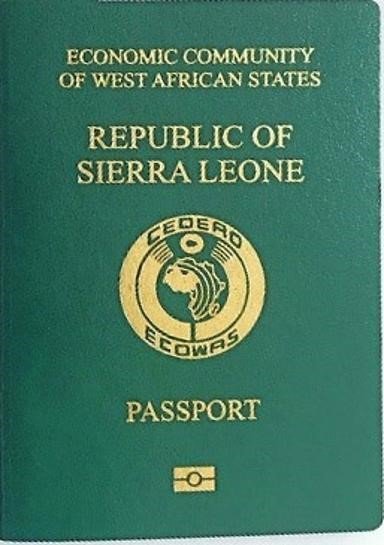
Growing concerns over constitutional violations, financial transparency and national security risks have intensified calls for the Government of Sierra Leone to immediately terminate the controversial passport production contract with Netpage (SL) Ltd.
The controversy follows revelations that the passport production agreement was allegedly renewed and extended for an additional five-year period without Cabinet approval or parliamentary ratification, raising serious questions about the legality of the arrangement.
The issue was first formally raised by Parliament’s Public Accounts Committee (PAC) in March 2025. In its report, the Committee strongly faulted the Sierra Leone Immigration Department and the Ministry of Internal Affairs for what it described as gross negligence and a blatant disregard for the provisions of the 1991 Constitution.
The PAC report, signed by its Chairman and Deputy Speaker of Parliament, Hon. Ibrahim Tawa Conteh, stated that the new agreement had not been submitted to Cabinet for consideration or presented to Parliament for ratification as required under the law.
“The Committee faulted the Immigration Department and the Ministry of Internal Affairs for failing to table the new agreement to Cabinet for consideration and finally to Parliament for approval,” the report concluded.
Prior to the report, Hon. Ibrahim Tawa Conteh had issued a warning letter dated 12 February 2025 urging the Ministry of Internal Affairs to strictly comply with constitutional procedures by ensuring that the agreement between the Government of Sierra Leone and Netpage was properly presented to Parliament.
Despite the warning, reports indicate that the contract extension proceeded without the necessary constitutional approvals, prompting critics to argue that the agreement is legally questionable and should therefore be nullified.
Legal analysts point to Section 118 of the 1991 Constitution, which requires agreements of national importance involving the Government to be approved by Parliament before they can take effect. Passports, as sovereign state documents, fall within this category.
Observers argue that the failure to follow the constitutional process undermines parliamentary oversight and sets a dangerous precedent for the management of critical national contracts.
Beyond the constitutional concerns, the financial implications of the agreement have also triggered widespread debate.
According to the Institute for Governance Reform (IGR), Sierra Leone produces between 65,000 and 70,000 passports annually, generating estimated revenues of between 7 million and 9 million United States dollars each year.
Over the past decade, passport production is believed to have generated more than 70 million dollars in total revenue. However, governance watchdogs claim that the Government of Sierra Leone has received little or no royalty payments from the arrangement.
It could be recalled that in August 2021, the Financial Secretary at the Ministry of Finance reportedly instructed that the Government should begin receiving royalties from Netpage in an attempt to address the revenue imbalance.
However, complications later emerged when the Public Accounts Committee ruled that the royalty clause lacked constitutional backing because it was not included in the original agreement ratified by Parliament.
Subsequently, Netpage requested the refund of approximately Le5.2 billion that had been paid as royalties for the 2022 financial year. The company reportedly indicated that the refunded amount would be used to offset tax obligations with the National Revenue Authority.
Critics argue that the sequence of events raises troubling questions about the financial management of the contract and the extent to which the country may have lost significant revenue from passport production over the years.
In addition to financial and legal concerns, security experts have warned that uncertainty surrounding the management of Sierra Leone’s passport system could undermine international confidence in the country’s travel documents.
Over the years, there have been reported cases in which Sierra Leonean passports were found in the possession of individuals involved in criminal activities abroad, including deportees who were later discovered not to be citizens of Sierra Leone.
Analysts warn that any weakness in the oversight or legal framework governing passport production could pose serious risks to national security and the integrity of the country’s identity management system.
Civil Society Organizations and governance advocates are now urging the Government to take decisive action by terminating the current contract and initiating a transparent international bidding process for passport production.
They argue that opening the process to credible local and international bidders would ensure stronger security standards, improved revenue arrangements and greater accountability.
For many observers, the Netpage passport contract has now become a critical test of Sierra Leone’s commitment to constitutional governance, fiscal transparency and the protection of national interests.
With the constitutional legitimacy of the agreement under scrutiny and public concern continuing to grow, pressure is mounting on the Government to terminate the contract and restore confidence in the country’s passport production system. https://thecalabashnewspaper.com/calls-grow-to-terminate-netpage-passport-contract-over-transparency-revenue-and-security-issues/

No comments:
Post a Comment