By Foday Moriba Conteh
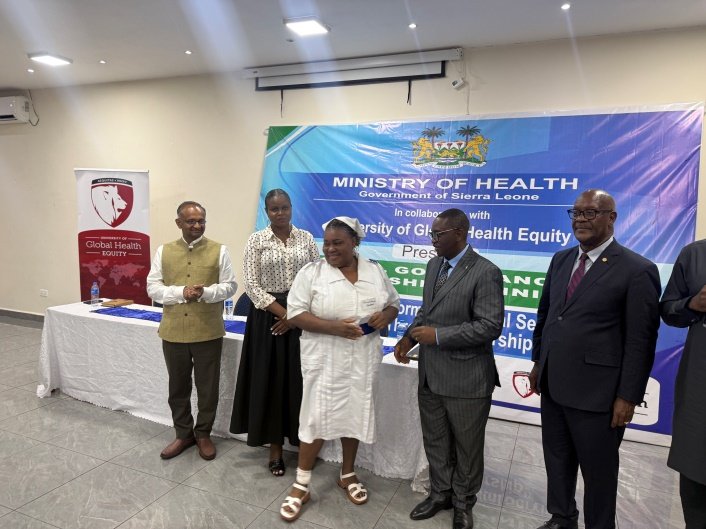
The Ministry of Health Sierra Leone, in collaboration with the University of Global Health Equity (UGHE) in Rwanda, has conducted a Hospital Governance and Leadership Training for top Management officials from selected Government hospitals across the country. The training brought together hospital Medical Superintendents, Matrons and Administrative Secretaries and was held at the New Brookfields Hospital in New England Ville.
The initiative was aimed at strengthening leadership, governance and management capacity among hospital administrators in order to improve healthcare delivery and patient outcomes across Sierra Leone.
Speaking during the training, the Minister of Health, Dr. Austin Demby, called on hospital leaders to demonstrate strong governance, accountability and professionalism in managing health facilities.
Dr. Austin Demby noted that hospitals play a critical role in the healthcare system and often serve people at their most vulnerable moments. He emphasized the need for hospital administrators to ensure that patients receive quality care and leave health facilities with confidence in the services provided.
“Patients come to hospitals uncertain of what they will experience. Our responsibility is to ensure that they leave confident and satisfied with the care they receive,” he said.
The Health Minister highlighted the progress Sierra Leone has made in expanding access to primary healthcare over the years. According to him, approximately 85 percent of the country’s population now has access to a health facility within a five-kilometer radius.
Despite those gains, Dr. Austin Demby stressed that improving the overall healthcare system requires addressing four key pillars: physical infrastructure, human resources, medical supplies and essential drugs.
He explained that health facilities must be clean, safe and properly equipped in order to attract patients and encourage them to seek care. Facilities lacking basic amenities such as water, electricity and proper roofing, he said, discourage patients from visiting even when they exist.
Dr. Austin Demby also underscored the importance of qualified and motivated healthcare workers, noting that effective service delivery depends heavily on skilled professionals who demonstrate compassion and commitment to patient care.
He further emphasized the need for consistent availability of medical supplies, particularly essential drugs, across the country’s more than 1,600 health facilities.
The Minister acknowledged that although significant investments have been made in primary healthcare, there is now an urgent need to strengthen secondary and tertiary healthcare facilities, including district and referral hospitals. Many of those facilities, he noted, were built decades ago and require modernization to meet current healthcare demands.
Dr. Austin Demby also warned that international funding for healthcare systems in developing countries is declining, urging Sierra Leone to strengthen domestic resource mobilization and develop sustainable financing mechanisms.
“As external support reduces, we must take greater responsibility for our own healthcare system by managing our resources well and exploring options such as health insurance,” he said.
Also speaking at the event, Professor Nobhojit Roy, Chair of the Centre for Leadership at UGHE, commended the Ministry of Health for prioritizing leadership and governance training within the healthcare system.
He thanked the Ministry for the opportunity to partner with Sierra Leone in strengthening leadership capacity in the health sector.
Professor Nobhojit Roy praised the dedication of participants who attended the training despite it being held on a public holiday and during the Ramadan fasting period.
He stressed that hospitals are not defined only by infrastructure or equipment but by the people who work within them.
“Hospitals are about people. When health workers feel valued and respected, everything changes,” he said.
The professor also highlighted the importance of South-South collaboration, explaining that African countries can learn from one another rather than relying solely on training in Western nations.
“Africa can train Africa,” he said, adding that institutions on the continent possess valuable experience and knowledge that can help strengthen health systems.
According to him, the UGHE Centre for Leadership works with Ministries of Health in various countries to design customized training programs tailored to specific national needs. These programmes focus on areas such as health financing, digital health, vaccination programmes and health system management.
In Sierra Leone, he noted, the partnership aims to support the implementation of the country’s National District Hospital Strategic Plan, which is designed to improve the performance and management of district hospitals.
The Deputy Chief Medical Officer (Clinical), Dr. Mustapha Kabba, said the training forms part of broader national efforts to strengthen leadership within the healthcare system.
He explained that the programme aligns with the Government’s goal of achieving zero preventable maternal deaths, zero preventable neonatal deaths and zero unvaccinated children.
“This training equips hospital leaders with the knowledge and skills they need to effectively manage their facilities and drive improvements in healthcare delivery,” Dr. Mustapha Kabba said.
He noted that strengthening leadership at the hospital level is essential to improving the performance of the entire healthcare system. According to him, the initiative also complements the Government’s ongoing health sector transformation agenda.
Dr. Mustapha Kabba further stated that participants will be expected to apply the knowledge gained from the training within their respective institutions, with performance monitored through key indicators to ensure accountability and measurable improvements in service delivery.
Also addressing the participants, the Permanent Secretary of the Ministry of Health, Andrew L. Sorie, commended hospital administrators for their commitment to the training.
He described their attendance during a public holiday as a demonstration of dedication to improving healthcare services in Sierra Leone.
“You come from institutions that are meant to give life to people and your presence here shows the sacrifices you are making to improve the system,” he said.
Andrew L. Sorie stressed that while infrastructure and equipment are important, the quality of care ultimately depends on how hospital staff collaborate and treat patients.
He encouraged hospital leaders to strengthen teamwork within their institutions and ensure effective supervision of staff to improve service delivery.
On behalf of the trainees, Betsy I.S.D Deen, Senior Matron at the Princess Christian Maternity Hospital, expressed appreciation to the Ministry of Health for organizing the training.
She explained that the leadership structure of Government hospitals typically includes the Medical Superintendent, the Hospital Matron and the Hospital Secretary, who work together to ensure effective management and governance.
According to her, the training has provided participants with practical leadership and governance skills that will help them improve service delivery in their respective facilities.
She noted that the programme includes both in-person sessions and three months of online follow-up training, which will allow participants to continue strengthening their leadership skills.
Matron Betsy I.S.D Deen acknowledged that hospitals face challenges such as staffing shortages, financial constraints and workplace conflicts but emphasized that effective leadership and teamwork can help address these issues.
“At the end of the day, the ultimate beneficiaries are the patients because better leadership in hospitals will lead to improved quality of care,” she said.
The training forms part of ongoing efforts by the Ministry of Health and its partners to strengthen hospital governance and enhance the overall quality of healthcare services in Sierra Leone. https://thecalabashnewspaper.com/moh-ughe-train-hospital-administrators-on-governance-and-leadership-to-improve-service-delivery/

No comments:
Post a Comment