By Amin Kef (Ranger)
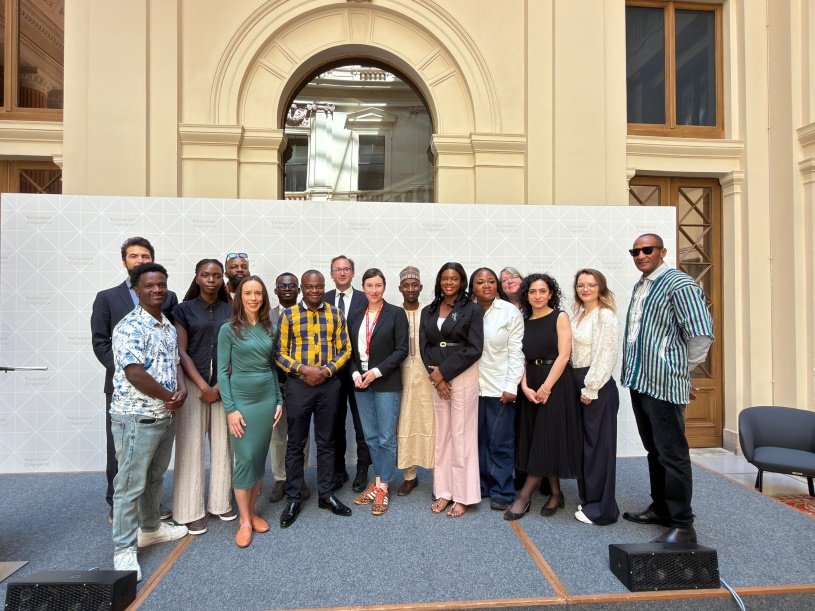
Ten accomplished journalists from seven African countries have successfully concluded an intensive week of high-level professional engagements, institutional visits, media exchanges and cultural interactions under the Austria-Africa Media Fellowship Programme 2026 held in Vienna, Austria, from May 17 to 22, 2026. The fellowship programme, organized by the Austrian Federal Ministry for European and International Affairs in collaboration with the International Press Institute (IPI), focused extensively on press freedom, journalist safety, media innovation, sustainability, democracy and international media collaboration.
The fellowship brought together media professionals from Nigeria, Ghana, Sierra Leone, Kenya, South Africa, Ethiopia and Zimbabwe, creating a platform for cross-border professional dialogue and knowledge-sharing on some of the most pressing challenges confronting journalism globally, particularly in Africa. Participating journalists included Favour Ulebor-Emmanuel of Vanguard Newspaper in Nigeria, Alhassan Bala, Founder and Editor of Alkalanci (The Arbiter) in Nigeria, Albert Oppong-Ansah of the Ghana News Agency, Amin Kef Sesay, Managing Editor of The Calabash Newspaper in Sierra Leone, Miriam Angil of Swahilipot Hub Foundation in Kenya, Clement Manyathela of Radio 702 in South Africa, Erin Marisa Bates of Carte Blanche in South Africa, Eyasu Zekarias Tadesse of Capital Ethiopia/FM 97.7, Ernestina Asante of GhanaWeb and Farai Shawn Matiashe, an international journalist from Zimbabwe.
Activities officially commenced on Sunday, May 17, 2026, with the arrival of fellows in Vienna, where participants were welcomed and accommodated at Flemings Selection Hotel before participating in introductory networking and cultural engagements aimed at fostering interaction among the journalists and organizers.
On Monday, May 18, the fellows engaged Austrian Government officials at the Federal Ministry for European and International Affairs during a high-level briefing on Austria’s foreign policy and the country’s candidature for the United Nations Security Council for 2027–2028. The session was led by Ambassador Jan Kickert, Special Envoy for Austria’s candidature to the Security Council, who discussed Austria’s diplomatic priorities, multilateral engagement and international cooperation efforts.
The journalists later toured Vienna’s historic First District before proceeding to the United Nations Office in Vienna, where they participated in lectures and discussions involving officials of the United Nations Office on Drugs and Crime (UNODC) and the International Atomic Energy Agency (IAEA). Among the speakers were Elena Rigacci Hay, Chief of the Africa Regional Section at UNODC, Marie Caronile, Programme Officer for the Regional Section for Africa and the Middle East and Sinead Harvey, Press and Public Information Officer at the IAEA. Discussions focused on global security, international cooperation, public communication, Africa-related programmes and the role of international institutions in promoting peace and development. The fellows also held an informal engagement with Tariq Rauf, former Head of Verification and Security Policy at the IAEA, on international diplomacy and global security policy.
On Tuesday, May 19, participants visited the Austrian Parliament, where they interacted with Members of Parliament including Andreas Minnich and other officials on democratic governance, legislative processes and political accountability. Later, the fellows engaged Sepp Schellhorn, State Secretary at the Federal Ministry for European and International Affairs, in discussions centered on Austria-Africa relations, media literacy, tourism, investment opportunities, diplomacy and the growing global challenge posed by misinformation and fake news.
Wednesday, May 20, featured extensive engagements on Austria’s Africa Strategy and development cooperation. The journalists held discussions with Stefan Scholz, Head of the Department for Sub-Saharan Africa and the African Union, Roberto Thym, Deputy Head of the Department for Business Services, Regina Rusz, Director General for Cultural Diplomacy and Edwin Kleiber, Chief Executive Officer of AMEX Health. The sessions focused on Austria’s engagement with African countries, development cooperation, business partnerships, cultural diplomacy and international collaboration.
The fellows later met Austria’s Federal Minister for European and International Affairs, Beate Meinl-Reisinger, before proceeding to the Austrian Development Agency (ADA), where discussions centered on development cooperation, peacebuilding, sustainability and environmental issues. Sophia Stanger of the Austrian Center for Peace engaged the journalists on environmental peacebuilding and global cooperation around climate-related challenges.
A major highlight of the fellowship occurred on Thursday, May 21, when participants visited ORF Zentrum Küniglberg, Austria’s national public broadcaster, where they toured the newsroom facilities and participated in extensive presentations and discussions on public-service journalism, newsroom operations, audience trust and digital broadcasting. The fellows also visited Radio Afrika and engaged Austrian journalists and media practitioners in discussions on migration reporting, diversity, inclusion and cross-cultural storytelling.
The journalists further visited the Austrian Presidential Office at Hofburg Palace, where they gained deeper understanding of Austria’s governance system and democratic institutions before concluding the day with networking engagements involving Austrian journalists at Heuriger Schübel-Auer. The interaction provided opportunities for professional networking, collaboration and exchange of ideas between African and Austrian journalists.
The final day of the fellowship on Friday, May 22, focused extensively on press freedom, journalist safety, media innovation and sustainability during engagements hosted by the International Press Institute. Fellows interacted with Austrian local journalism projects facilitated by the Austrian Chamber of Commerce, including Startseite, Inselmilieu Reportage and The International, where discussions focused on podcast storytelling, community journalism, inclusive reporting, audience engagement and innovative approaches to sustaining independent journalism in the digital era.
The journalists also engaged Miriam Mukalazi, Director of the Africa Program at the Vienna Institute for International Dialogue and Cooperation, on Africa-Europe cooperation, media development and dialogue initiatives.
During the farewell engagement hosted by IPI, Executive Director Scott Griffen underscored the organization’s commitment to defending press freedom and supporting journalists globally. He explained that IPI’s work revolves around four major pillars: press freedom and journalist safety, support to journalism, media innovation and sustainability and strengthening the global membership network. Scott Griffen emphasized that attacks against journalists, intimidation, censorship and impunity remain major threats to independent journalism worldwide, stressing the need for accountability and stronger international solidarity among journalists.
He disclosed that IPI continues to support investigative journalism, legal assistance, hostile environment training and innovation programmes designed to help news organizations adapt to artificial intelligence, digital disruption and changing audience behaviour while maintaining editorial independence. According to him, IPI’s media innovation and sustainability programmes seek to strengthen independent journalism through incubator and accelerator initiatives that help media organizations develop sustainable business models and innovative news products.
Grace Linczer, Membership and Engagement Manager at IPI, formally welcomed the African journalists into the IPI global network and announced that each fellow had received one-year IPI membership. She explained that the membership provides access to professional networking opportunities, workshops, leadership programmes, advocacy support, newsletters, member-only events and the broader global network of journalists and editors across more than 110 countries.
Questions raised by the African journalists throughout the fellowship centered on journalist killings, attacks against media practitioners, misinformation, artificial intelligence, investigative journalism, media sustainability, digital transformation and accountability for crimes committed against journalists, especially within conflict zones and politically challenging environments. Discussions also explored strategies for strengthening ethical journalism, fact-checking, audience trust and international collaboration in combating disinformation.
Speaking at the conclusion of the programme, Amin Kef Sesay of The Calabash Newspaper in Sierra Leone described the fellowship as enriching and transformative, noting that the engagements provided valuable exposure to Austria’s diplomatic institutions, media systems, democratic governance and innovation frameworks. He stated that the knowledge, skills and professional relationships gained during the fellowship would contribute significantly toward strengthening journalism and national development efforts in Sierra Leone.
The Austria-Africa Media Fellowship Programme 2026 concluded with renewed commitments toward strengthening international media collaboration, promoting press freedom, enhancing journalist safety and supporting sustainable independent journalism across Africa and beyond. https://thecalabashnewspaper.com/ten-african-journalists-end-landmark-vienna-fellowship-with-renewed-drive-for-independent-journalism-ipi-global-membership/

No comments:
Post a Comment