By Amin Kef Sesay
Austria has reaffirmed its commitment to strengthening bilateral relations with Sierra Leone following the official opening of refurbished premises for the Austrian Honorary Consulate in Freetown and a series of high-level engagements focused on youth empowerment, diplomacy, regional security and international justice.
The new Honorary Consulate of the Republic of Austria - located on 18 Spur Road, Freetown—was formally inaugurated on Monday, February 23, 2026, by Austria’s Deputy Minister of European and International Affairs, His Excellency Dr. Nikolaus Marschik. The ribbon-cutting ceremony was attended by senior officials of the Government of Sierra Leone, members of the diplomatic corps and a visiting Austrian delegation, marking what Austrian officials described as a renewed and more visible diplomatic presence in the country.
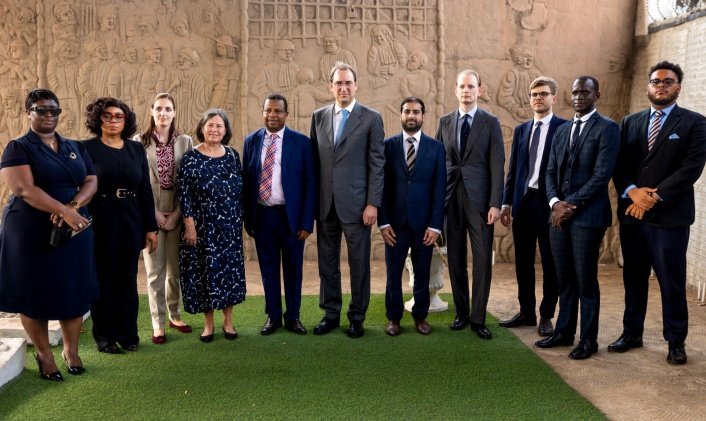
Among those present on the Sierra Leonean side were the Deputy Minister of Foreign Affairs and International Cooperation, Hon. Francess Piagie Alghali, and the Minister of Planning and Economic Development, Kenyeh Barlay, alongside ambassadors, high commissioners and other diplomatic guests. The Austrian delegation comprised H.E. Dr. Nikolaus Marschik; H.E. Ursula Fahringer, Austria’s Ambassador to Sierra Leone (resident in Dakar, Senegal); Mr. Gilbert Schenkenbach, Adviser to the Ministry of European and International Affairs of Austria; Ms. Sophie Jenerwein, Secretary of Legation; Mr. Felix K. Bigl, Premier Secrétaire (Affaires Administratives) and Consul; and Mr. Ram Mahboobani Shankerdas, Austria’s Honorary Consul to Sierra Leone.
Speaking during the opening, Dr. Nikolaus Marschik described the occasion as “a fantastic and wonderful evening” in the history of relations between Austria and Sierra Leone, stressing that the visit went beyond ceremonial diplomacy to include intensive political and development engagements. “We really had interesting and intensive relations today. We had a political dialogue. We discussed bilateral issues. We discussed challenges in our respective neighborhoods. And we also discussed how we can together strengthen an international rules-based order, which is so important to Sierra Leone,” he stated.
Dr. Nikolaus Marschik outlined three key areas he said defined the day’s engagements. First, he pointed to the political dialogue held earlier, emphasizing that discussions covered both bilateral cooperation and wider regional dynamics. Second, he highlighted Austria’s longstanding support to youth development initiatives in Sierra Leone, particularly through Don Bosco programmes. Third, he said the opening of the refurbished honorary consulate premises represented a practical strengthening of Austria’s diplomatic footprint in Sierra Leone, anchored by the work of the Honorary Consul.
Commending Mr. Ram Mahboobani Shankerdas, Dr. Nikolaus Marschik said: “I really think that our Consul Ram is doing a fantastic job. I have seen you, we met yesterday evening when I arrived, and I’m really impressed by how professional, using your expertise and you really give an inspiration to us all.” He added that the upgraded consular presence was intended to enhance service delivery and deepen the day-to-day link between the two countries.
A major feature of the Austrian delegation’s visit was a tour of Don Bosco Fambul Technical and Vocational Institute in Freetown, where they witnessed vocational and technical training programmes designed to equip vulnerable youth, especially former street children, young mothers and those seeking a second chance, with practical skills in trades such as welding, carpentry, tailoring, ICT and other livelihood areas.
Explaining why Don Bosco was a central focus, Dr. Nikolaus Marschik told stakeholders: “We’re here to see what you’re doing and I really want to applaud and commend you, Father, and your team here at Don Bosco and the Don Bosco family for your important work. We were thinking what can we do to make a very small… contribution to your important work. And that’s why our embassy and our ambassador and our consul… were thinking of how can we support your important work and how can we come and look what you’re doing.”
He further referenced a component of Don Bosco programming supporting young women, noting that the institution was empowering “over 30 young women” to develop employable skills. “Don Bosco is helping and assisting and supporting about over 30 young women in getting to know, to learn, being IT experts, being tailors, being hairdressers. And it was really wonderful of seeing these young women so devoted to their work,” he said.
In a symbolic demonstration of Austria’s support for youth empowerment and skills development, Dr. Nikolaus Marschik announced a financial contribution to back Don Bosco’s ongoing work. “So we are bringing you a small financial support that I’m happy to give it to you. Father… here there’s a symbolic sum of 10,000 euros,” he disclosed, adding that investment in people remains central to Austria’s cooperation approach. “What you’re doing is investing into the most important what we have on earth and that’s people. People is the most important, and you are the most important, and if you have the chance to have a wonderful perspective, we are very happy to do it,” he said.
Welcoming the delegation, Rev. Fr. Edwin Ngeoyeh Tangie SDB, Rector and Director of Don Bosco Fambul Technical and Vocational Institute, described Don Bosco as “a beacon of hope” for vulnerable children and young people, stressing that international partnerships have a human impact beyond equipment and infrastructure. “The generous support from the Austrian people… does not simply buy equipment or pay for materials. It does something far more profound: it restores dignity,” he told the visiting team. He explained that beneficiaries gain not only technical competence but also renewed self-worth and independence, urging the delegation to look beyond the workshops and “look into the eyes of the students” to see hope and transformation.
Also speaking, Deputy Director Samuel Thomas Bojohn described Austria as one of Don Bosco Fambul’s longest-serving partners and recalled the consistency of support even during Sierra Leone’s civil war years. “Normally, we have been working with these vulnerable people. And during the difficult moments, especially during the war, it was the Austrian government that we have behind us… they have been the longest serving donors that have been working with us,” he said. While acknowledging that “10,000 euro” may appear modest externally, he emphasized its local impact: “For you, you say 10,000 euro donation is a small thing, but for us, it goes a long way to develop the minds of people of Sierra Leone,” he stated, while also referencing the broader Don Bosco infrastructure beyond Freetown, including facilities in rural communities on the peninsula.
A beneficiary of the programme, Kadija Bangura, credited Don Bosco’s skills training for transforming her life and enabling her to become financially independent. “I want to thank Don Bosco for transforming my life. Through their skill training programs, I have been equipped with skills… that I now use to support myself financially. I kindly call on the donors to continue their support as there are other young women like me in need of empowerment,” she appealed.
In her remarks during the consulate opening, Ambassador Ursula Fahringer thanked her team for making the event possible and expressed optimism that the visit would serve as a turning point in Austria–Sierra Leone relations. In an interview with journalists, she provided historical context, stating that Austria has maintained an honorary consulate in Sierra Leone since 1958, though it was temporarily closed in 2015 and later reopened in 2023 with the appointment of Mr. Ram Shankerdas as Honorary Consul. “We have had an honorary consulate in Sierra Leone since 1958. Then it was temporarily closed in 2015 and in 2023 we reopened it with Mr. Ram Shankerdas as an honorary consul. And now we offer these fantastic premises… in a super location and we are very happy for its generosity and the fantastic work… done here,” she said.
Ambassador Fahringer added that a second goal of the occasion was to facilitate Dr. Marschik’s visit to Sierra Leone. “We managed to convince our Deputy Foreign Minister to visit Sierra Leone on the occasion of the opening of this premises in Freetown today. We visited projects which are supported by Austria,” she noted.
Significantly, she described the delegation’s courtesy visit to Vice President Dr. Mohamed Juldeh Jalloh as a landmark engagement. “Our visit to the Vice President was the first bilateral visit of… a high-ranking Austrian delegation in this century,” she said, adding that the meeting addressed bilateral and multilateral issues as well as regional security dynamics, particularly the Sahel. “We exchanged on the situation in the region because His Excellency is an expert on the Sahel region… it was a very intensive meeting and it was a very enriching talk,” she stated.
The ambassador also highlighted discussions with Freetown Mayor Yvonne Aki-Sawyerr OBE, describing the exchange as a useful first comparison of urban governance challenges. “The mayor explained to us the challenges of a capital city and we also exchanged what the challenges are for Vienna… There are some similarities, we have about 2 million inhabitants, Freetown has about 2 million inhabitants… Bo… has about 300,000 inhabitants… Austria’s second city… about 300,000 inhabitants. But there are also differences… so it was a first exchange on what she is doing here and what are her biggest challenges,” she explained.
Delivering a message directly to Sierra Leoneans, Ambassador Fahringer praised the country’s resilience and urged young people to take ownership of national development. “You have had some difficult years behind you, but you are a very resilient population… You have a young generation which is creative. Go ahead and forge the future of your country,” she said.
The Austrian delegation later visited the Peace Museum at the Residual Special Court for Sierra Leone (RSCSL), where they were briefed on Austria’s historical contributions to the court’s work. Principal Defender Ibrahim Yillah acknowledged Austria’s consistent financial and material support since the institution’s establishment and highlighted the contribution of Austrian jurist Dr. Renate Winter, whom he described as instrumental in shaping jurisprudence related to children’s rights and in establishing the recruitment of children in armed conflict as a prosecutable war crime.
During the tour, the delegation visited the archive room, memorial garden and exhibition hall before Dr. Marschik lit the Flame of Justice, a symbolic gesture underscoring Austria’s continued commitment to accountability, human rights and the rule of law.
From diplomatic consultations and governance exchanges to youth empowerment support and justice-sector engagement, the series of activities signaled what officials framed as Austria’s evolving and multi-dimensional partnership with Sierra Leone. By reopening and upgrading its honorary consulate, supporting vocational training for vulnerable youth and reaffirming backing for international justice mechanisms, Austria projected a renewed diplomatic footprint grounded in political dialogue, development cooperation and shared global values—while Sierra Leone, in turn, marked the moment as both a strengthening of bilateral ties and a reminder of the enduring importance of investing in people and institutions for a stable and prosperous future. https://thecalabashnewspaper.com/austria-strengthens-diplomatic-footprint-in-sierra-leone-opens-honorary-consulate-supports-don-bosco-with-e10000-visits-peace-museum/

No comments:
Post a Comment